Thursday, December 25, 2025
ADVT 
National

CFIB says internal trade barriers coming down, but patchwork could create challenges

Darpan News Desk The Canadian Press, 30 Jun, 2025 09:38 AM
  • CFIB says internal trade barriers coming down, but patchwork could create challenges

A new report by the Canadian Federation of Independent Business says progress has been made on removing trade barriers within Canada, but it adds that the patchwork of approaches could create new issues.

The organization's latest "internal trade report card" grades the federal and provincial governments based on factors related to interprovincial and territorial co-operation. It said Nova Scotia ranked highest in its 2025 evaluation, as the first province to introduce and implement mutual recognition legislation.

Mutual recognition refers to an arrangement where provinces or territories agree to accept the standards, regulations or laws in other jurisdictions.

Ontario was a close second after eliminating all of its Canadian Free Trade Agreement exceptions.

The federal and provincial governments have been working to remove internal trade barriers in the face of U.S. tariffs imposed by President Donald Trump.

SeoRhin Yoo, CFIB’s senior policy analyst for interprovincial affairs, said the internal trade file is "finally getting the attention is has desperately needed" since the CFTA was signed in 2017.

"Three years ago, we challenged governments to blow a hole through Canada’s internal trade barriers by adopting mutual recognition policies to get the flow of goods, services and people moving across the country. At the time, we heard all the reasons why it couldn’t be done," Yoo said in a press release.

"But just in the past six months we’ve seen seven jurisdictions with mutual recognition legislation on the books."

Ryan Mallough, CFIB's vice-president of legislative affairs, said the progress has been encouraging, but he pointed out the risk of having seven different jurisdictions taking seven different approaches to mutual recognition.

"That kind of patchwork can wind up recreating the barriers it was meant to knock down," said Mallough in a statement.

Prime Minister Mark Carney repeatedly vowed to "eliminate" interprovincial trade barriers and create "free trade by Canada Day" throughout the spring federal election campaign.

Carney's government has since passed its planned changes into law ahead of Canada Day. Bill C-5, the omnibus bill that reduces federal restrictions on interprovincial trade and also speeds up permitting for large infrastructure projects, became law on June 26.

But experts have said that law is only the first step of the process.

When Carney made his campaign promise, he was talking about cutting red tape put up by the federal government — not the rules set by the provinces, which have the most authority in this area.

"We’re marching the ball down field, but we haven’t reached the end zone just yet," said Mallough.

"The premiers and the prime minister have instructed the Committee on Internal Trade to reach a pan-Canadian mutual recognition agreement for December. We’ll be watching those conversations closely to ensure we cross the goal line and finally eliminate Canada’s internal trade barriers once and for all."

The CFIB has estimated that existing internal trade hurdles cost the economy some $200 billion a year.

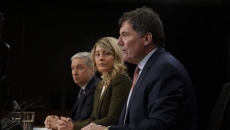
Picture Courtesy: THE CANADIAN PRESS/Sean Kilpatrick
MORE National ARTICLES

Bank of Canada cuts benchmark rate to 2.75%

Bank of Canada cuts benchmark rate to 2.75%
The Bank of Canada announces an interest rate cut as a cloud of uncertainty looms over the Canadian economy. Economists polled by Reuters widely saw the central bank lowering its key lending rate to 2.75 per cent, which marks its seventh consecutive cut.

Bank of Canada cuts benchmark rate to 2.75%

Canada to impose 25% tariffs on $29.8B in U.S. goods starting Thursday

Canada to impose 25% tariffs on $29.8B in U.S. goods starting Thursday
The federal government will impose 25 per cent tariffs on U.S. goods worth $29.8 billion in retaliation for steel and aluminum tariffs the administration of U.S. President Donald Trump imposed today. All countries, including Canada, were hit Wednesday with 25 per cent tariffs on steel and aluminum imports into the United States — part of Trump's attempts to realign global trade.

Canada to impose 25% tariffs on $29.8B in U.S. goods starting Thursday

White House says Trump dropping plan to double steel, aluminum tariffs

White House says Trump dropping plan to double steel, aluminum tariffs
After another chaotic day in Canada-U.S. relations, U.S. President Donald Trump dropped his threat to double tariffs on Canadian steel and aluminum imports after Ontario agreed to pause a surcharge on electricity exports. White House spokesman Kush Desai confirmed a 25 per cent tariff on steel and aluminum, with no exceptions, will go into effect for Canada and all other countries on Wednesday.

White House says Trump dropping plan to double steel, aluminum tariffs

B.C. takes advantage of U.S. 'chaos,' trade war to attract more doctors and nurses

B.C. takes advantage of U.S. 'chaos,' trade war to attract more doctors and nurses
The "chaos" in the United States provides an opportunity for British Columbia to recruit more American doctors and nurses, the province's health minister said as she announced changes aimed at fast-tracking the recognition of their credentials. Josie Osborne said "now is the time" for U.S. health workers to make the move.

B.C. takes advantage of U.S. 'chaos,' trade war to attract more doctors and nurses

Ford says Trump dropping plan to double steel, aluminum tariffs

Ford says Trump dropping plan to double steel, aluminum tariffs
Premier Doug Ford says U.S. Commerce Secretary Howard Lutnick has committed to lowering U.S. President Donald Trump's tariff on Canadian aluminum and steel back to 25 per cent after Ontario agreed to pause a surcharge on electricity exports to the United States.

Ford says Trump dropping plan to double steel, aluminum tariffs

Slower B.C. real estate sales blamed on U.S. tariff uncertainty, association says

Slower B.C. real estate sales blamed on U.S. tariff uncertainty, association says
The British Columbia Real Estate Association says tariff uncertainty has slowed housing activity.  A board report says there were 4,947 residential sales in the province last month, down 9.7 per cent from the same time last year. 

Slower B.C. real estate sales blamed on U.S. tariff uncertainty, association says