New research shows less snowpack in certain regions of Canada can have wide-ranging effects on everything from farms and wildlife to the broader economy.
The Concordia University study, published in the Nature journal "Communications Earth and Environment," says the usable water from snowpacks has dropped sharply in areas of the Canadian Rockies.
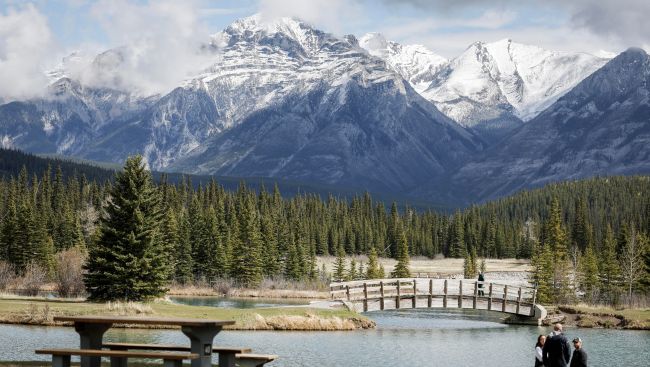
The mountainous region is the headwaters of major rivers in British Columbia and the Prairies, feeding communities and habitats.
Ali Nazemi, an associate professor at the university and an author of the study, has called the finding "creeping snow drought," which he says threatens Canada's water supply.
"You don't really realize it up to the time that you are in the middle of a crisis," Nazemi said in an interview.
The researchers analyzed snowpack data from 2000 to 2019, finding three per cent of Canada's land mass — areas of the Canadian Rockies — saw declines.
To determine losses, they measured the amount of water available in snowpack using satellite data and climate reanalysis techniques, Nazemi said.
He said while three per cent may seem small, the losses are situated in critical headwaters that downstream users heavily rely upon.
"(There) are a lot of social and economic activities blended there," Nazemi said.
The paper cites past Canadian climate events that suggest were a result of snowpack issues.
It says during a drought in 2015, low snowpack contributed to water shortages in British Columbia's Okanagan region where sockeye salmon populations collapsed. A lack of cooler water from mountain runoff caused warmer stream temperatures the fish couldn't survive in, the paper says.
The drought that year also reached the Prairies, causing less inflows into Saskatchewan's Lake Diefenbaker, a major reservoir. It resulted in strains to hydroelectric power generation and agricultural irrigation.
The paper also says a lack of snow more than 10 years ago in parts of Ontario and Quebec had affected the shipping industry.
It says due to little snow in 2011, there wasn't much meltwater to replenish the Great Lakes. It triggered an emergency situation, where harbours were dredged and ships lightened their loads.
In Quebec, dams were released so ships could come and go at the Port of Montreal, Nazemi said.
"We showed that St. Lawrence River might be one of the vulnerable places due to this," he said. "Perhaps we cannot take hydropower anymore (for) granted."
Despite declines in the Rockies, snowpack has increased in other areas, the research shows.
Nazemi said Canada's north is seeing more snow due to warming ice in the Arctic Ocean. As the ice melts, it releases more moisture into the atmosphere.
"This global warming is basically corresponding with both increasing snow water availability in the north … and also decreasing in the south in the mountains," he said.
"There are some other factors, like atmospheric and oceanic factors playing in that. So, we can say it's a combination of climate change and natural climate variability."
Nazemi said it would be alarming if the trends continue.
"We need to really think again about how we are managing our water and how we are developing around that new reality of water," he said. "We have a lot of people talking about the fact that the water future might actually be different from what we have now."
He said the Canada Water Agency, along with the Global Institute for Water Security in Saskatchewan, are working to address future scarcity issues.
But there needs to be better ways to assess problems at local levels, he added.
"What is actually happening in a neighbourhood, in a community, in a farm, in a wetland?" he said. "In part of this paper, we showed that when we go to the smaller scale … the uncertainties can actually be skyrocketing."
The research received funding from the Canadian government through grant programs.
Picture Courtesy: THE CANADIAN PRESS/Jeff McIntosh