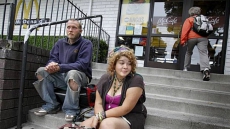
THUNDER BAY, Ont. — Stephane Boyer's nostrils flare and his breathing quickens, his lips failing to separate, when he thinks about Doreen — his partner of 22 years who died in August.
Doreen, who lived first in sub-standard housing and then on the street, was among 17 people who died on the streets of Thunder Bay, according to a new federally organized homeless census that illustrates the depth of disparity across the country.
The numbers, of course, only tell part of the story.
One woman was found dead in a laneway behind City Hall that's visible from the mayor's office. A local aboriginal artist who struggled with addiction was pulled from the river.
In Vancouver's downtown eastside, arguably Canada's most notorious poverty-stricken neighbourhood, six deaths in a year was out of the ordinary, said Brad King, who now oversees operations at Thunder Bay's largest shelter.
These days, anecdotes and statistics alike say Thunder Bay is among the worst cities in Canada for homelessness. The circumstances that render and keep people homeless are aligned in this northern Ontario city in a way that local officials are only just now learning about in greater detail.
Like Thunder Bay, 29 other small and medium-sized cities are taking part in either the federally organized count of homeless people or a similar effort organized by the anti-poverty group 20,000 Homes.
The hope is that the data will paint the most detailed picture yet of the homeless population in Canada, after years of estimates of the number of people who go homeless each night and each year — about 35,000 and 230,000, respectively.

Differing methodologies from one city to the next have also made it difficult to compare results on a national scale.
To help, the federal government has quietly collected a growing amount of information over the last three years on people visiting shelters, a relatively reliable measure because it captures many of the people who are homeless in a community.
That data has illustrated a remarkably consistent picture of shelter users and homelessness across the country that suggests homeless populations have similar makeups from city to city.
"The stability is what stands out to me," said Aaron Segaert, a researcher with Employment and Social Development Canada who wrote the first baseline study on shelter usage in Canada.
"Even when you look within the homeless population at different sub-groups — say youth, males, females, families, whatever — it tends to be remarkably similar from city to city and from year to year."
That's not to say there aren't differences between communities.
Federal data shows that in Peel Region, next to Toronto, 12.3 per cent of shelter users are immigrants and 3.9 per cent are refugees. In Prince George, B.C., women experience more 'episodic homelessness' — three or more homeless episodes a year — than men, the reverse of most communities outside the North.
Nanaimo's mild weather makes it easier for people to sleep outside, and the local jail adds to the homeless population because inmates have "nowhere to go when they finish their sentence." The largest proportion of shelter users in Thompson, Man., are senior males.
The figures show that the homeless population is most often male, between the ages of about 25 and 64, and often aboriginal, a demographic typically over-represented in homeless populations.
Boyer's story, in other words, is not out of the ordinary — it is the ordinary.
"I never seen no change at all," he says of the homeless situation in Thunder Bay.
"Nothing much change since I been here for 20 some years."

The hope is that the national data can help communities craft better plans to combat homelessness and organize services, and also inform plans for a national poverty reduction strategy the federal Liberals have promised to deliver.
"It's a really tough to get people to do anything when ... you can't give them the data," said Bonnie Krysowaty with the Lakehead Social Planning Council.
"That's why this point-in-time count was so important for Thunder Bay, because we haven't had this kind of data ... our city councillors really like to see the data, they like to see the numbers."
Back at the rooming house, a puppy — rescued from the street — whines from behind the door of Boyer's bedroom. Boyer opens the door and the dog runs into the hallway, a slipper in its mouth.
Doreen always wanted a dog, he says ruefully.