OTTAWA - Newly released documents show the Liberals were told earlier this year that the government's bid to lock in low interest rates on federal debt could run into problems unless the Bank of Canada stepped in.
The low rates have been a key economic rationale for why the government can afford the elevated spending and deep deficits needed to put a financial floor under businesses and workers impacted by COVID-19.
Although longer term bonds carry higher rates of interest than short-term options, they lock in debt at what are still rock-bottom rates.
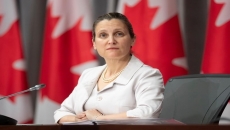
Documents provided to Finance Minister Chrystia Freeland ahead of the April budget say the Finance Department and Bank of Canada were told to avoid issuing any new, super-long-term bonds because of limited appetite from investors.
The documents released to The Canadian Press under the access-to-information law say any such bonds could affect yields unless the central bank sopped up debt through its purchasing program, known as quantitative easing.
“Demand for more long-term bonds is limited and there is little room to issue more without impacting yields, unless the Bank of Canada continues to buy most of the higher debt issuance through its quantitative easing (QE) program," reads part of the documents.
The government did offer up 50-year bonds once this year and the sale appears to have gone well, even as the Bank of Canada has eased the pace of its bond purchases.
As the bank pulls back from purchases, demand for federal bonds would drop and rates would rise, which could affect the cost for the federal government to refinance billions in debt coming due.
"There are a few red flags, but the government can afford to be running these deficits because their debt servicing costs are incredibly low," said Steve Ambler, an economist with the University of Quebec in Montreal.
"We've seen real interest rates around the world gradually dropping and they're at very, very low levels right now."
The expectations of interest rate increases on the near horizon may be causing buyers to be reluctant to buy bonds that mature in 30 years or more because they would take a financial hit on their resale value, said Ambler, who is also the David Dodge Chair in Monetary Policy at the C.D. Howe Institute.
Bond yields recently rose after the Bank of Canada's counterpart south of the border, the U.S. Federal Reserve, indicated last month it was ready to roll back its quantitative easing program.
"Regardless of how you forecast, it might become more expensive to borrow, but I don't think the yield curve being a little more steep … says that you should change your strategy," said aid Dominique Lapointe, senior economist at Laurentian Bank Securities.
The March briefing note to Freeland said rates would be low to 2023 then gradually rise, before adding that "rates have been trending down for quite some time" alongside a graph showing their path staying below economists' expectations for years.
The path for interest rates is one uncertainty facing the government as it goes about its budgeting process, said Christopher Ragan, director of the Max Bell School of Public Policy at McGill University. The other, he said, is how long relief programs will last.
"There is no doubt that budgets these days are facing more uncertainty than normal budgets and that's just the nature of the beast," Ragan said.
"There's nothing you can do about that, but I think you do have to recognize the uncertainties."
The Liberals have been asked to extend the wage and rent supplements for businesses, and recovery benefit for unemployed workers, beyond their current end date of Oct. 23.
Freeland said Wednesday the government was considering the request, and that the government would have more to say soon.
"While some sectors of the economy are recovering very robustly, and that is great, there are some sectors that have been, and continue to be, particularly hard hit," she said during a news conference.
"We are working on ways to ensure that support is there for them."