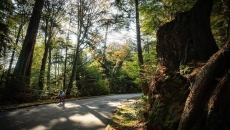
VANCOUVER - First came the moths. Then came the drought.
The trees of Stanley Park, typically the green jewel of Vancouver's downtown core, just can't catch a break.
Experts say large numbers of browning trees appear dead or dying, because of a one-two combination of foliage-munching grubs and an exceptionally dry weather spell, with the last appreciable rain falling in Vancouver on Sept. 4.
City of Vancouver arborist Joe McLeod said trees already stressed by infestations of western hemlock looper moth larva have been further pushed toward breaking point by the prolonged summer-like conditions.
“Much like humans, the more stressed we are, the more susceptible we are to getting colds and other conditions," said McLeod.
“Unfortunately, I think the fact that there is an insect outbreak that is happening and the fact that we have very extreme heat and then extreme cold — it’s definitely lending itself to a worse situation than previous years."
Such "multiple layers of stress" added up to a higher likelihood of tree mortality, said McLeod.
Dead trees could be seen in the park's Prospect Point area, as well as facing Coal Harbour, English Bay and the northern edge of the park, said McLeod.
Richard Hamelin, the department head of forest conservation sciences at the University of British Columbia, agreed that it's not just the ongoing problem of the looper moths that is killing trees.
“The heat and the drought are like additional stress that affects those trees," said Hamelin.
"If it were just for the insect, maybe the trees would recover,” said Hamelin, who has been monitoring the health of trees throughout the park over the last four years.
McLeod, acting manager of urban forestry, fleet and strategic planning at the Vancouver Board of Parks and Recreation, said the moth outbreak is in its fourth year.
The moth's larval grubs mostly target western hemlocks, but will jump to Douglas fir and other species when the hemlocks are consumed.
The moth outbreaks are cyclic, and typically last one to three years.
The impact of the grubs has made trees particularly susceptible to the drought conditions, Hamelin said, because the lack of foliage and buds is making it difficult for trees to store water and recover next year.
McLeod said that spraying Stanley Park's trees with pesticide could have negative consequences on beneficial insects.
He said his team put out a request for proposals last week, asking experts to come up with suggestions about how to manage the moth outbreak.
“So our hope is that with the input of professional foresters and other professionals, we can get a report that guides the response, not only in terms of risk management but also in terms of how to improve the ecological health of the forest within Stanley Park,” said McLeod.
He added that the report will also focus on how to restore the forest in the face of climate change, as well as moth outbreaks.
In the meantime, McLeod said his team would address hazards posed by the dead and dying trees.
That included working with the Coastal Fire Centre, a wildfire risk-assessing body in B.C.
But McLeod said recent cooler nights, bringing dew, may have reduced the risk of a fire in the park.
“We are actively pursuing solutions to mitigate risks and move the Stanley Park forest in a better ecological direction. But that being said, there are many challenges that we will encounter and it’s a complex ecosystem," McLeod said.
“We appreciate the community’s patience as we navigate this and we just want to get it right because it’s such a jewel to the community."