
Wednesday, July 1, 2026
ADVT 
National

Fact File: Posts falsely claim Canada revoked China's equal trade status

Darpan News Desk The Canadian Press, 11 Dec, 2025 11:52 AM
  • Fact File: Posts falsely claim Canada revoked China's equal trade status

Chinese language posts that appeared on social media the past few weeks claimed Canada was one of 32 countries to revoke China's "most favoured nation" trade status on Dec. 1. 


The claim originates from a 2021 rumour that conflates most favoured nation status with "generalized system of preference" certificates, which China stopped issuing to Canada and other countries on Dec. 1 that year. 


China remains a most favoured nation by Canada, meaning it is entitled to equal treatment as a trading partner.


THE CLAIM


Since November, several Chinese language posts across western social media claimed Canada was one of 32 countries to revoke China's "most favoured nation" status. 


Most favoured nation refers to a trade principle that entitles trading partners to equal status. Countries that trade as World Trade Organization members are required to provide the same trade benefits to all countries, with some exceptions. 


An image posted to the X platform, formerly Twitter, and multiple times on Facebook claimed Canada is one of 32 countries that removed China's most favoured nation trade status as of Dec. 1.
Similar claims appeared several times on Threads, as well as YouTube. 


THE FACTS


A keyword search of the Chinese language text shows this isn't the first time the claim appeared online. 


In 2021, Hong Kong-based HKBU Fact Check reported on the claim, which seemingly originated from a Facebook post. The post made an identical claim about 32 countries removing China's most favoured nation status on Dec. 1. 


However, a further keyword search shows the original announcement made by the General Administration of Customs China that references the 32 countries.


In the announcement, the customs agency said it would stop issuing generalized system of preference (GSP) certificate of origins for goods exported to 32 countries, including Canada and the European Union. 


The certificates grant preferential tariffs to imports from developing countries, according to the World Trade Organization. 


The Chinese customs agency said some countries pulled their GSP treatment for China over the years, since rapid economic development meant China was no longer considered a low-income country. The agency said it would stop issuing GSP certificates of origin to the 32 countries on Dec. 1. 


A 2021 article from China Briefing discussed the confusion over the announcement, noting the 32 countries stopped giving China GSP status over several years and not all at once. Canada removed its version of the GSP for China and 71 other countries as of Jan. 1, 2015. 


China and Canada are both part of the World Trade Organization, and remain entitled to most favoured nation status. China remains on Canada's list of countries afforded that status. 


Canada removed most favoured nation status from Russia and Belarus on March 2, 2022 in response to the Russian invasion of Ukraine, and imposed a general tariff of 35 per cent to most goods.

However, it made an exception for cobalt-60, a radioactive isotope used in some medical goods, as the government said it was unable to source enough elsewhere. 

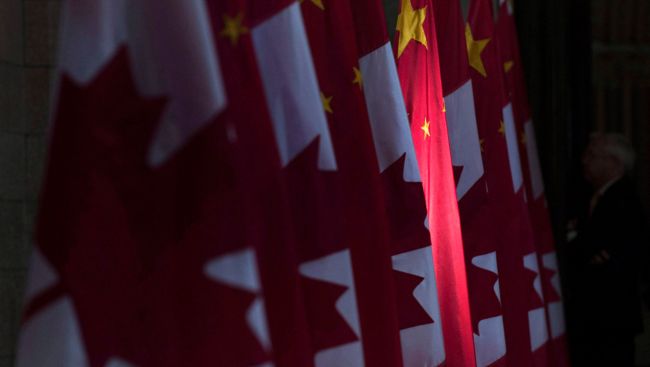
Picture Courtesy: THE CANADIAN PRESS/Adrian Wyld

MORE National ARTICLES

Weak loonie signals economy is 'in trouble': currency expert

Weak loonie signals economy is 'in trouble': currency expert
The Bank of Canada's end-of-day exchange rate Monday had the loonie trading at 68.48 cents US, but the Canadian dollar neared 70 cents in the minutes after Prime Minister Justin Trudeau said the planned tariffs would be paused for at least 30 days. The overall trend for the Canadian dollar however has been weak, which has implications for the economy. 

Weak loonie signals economy is 'in trouble': currency expert

Interprovincial trade barriers: what they are, why they exist and how to cut them

Interprovincial trade barriers: what they are, why they exist and how to cut them
The Trump administration's on-again, off-again threat to impose damaging tariffs has boosted an old idea for driving economic growth in Canada: eliminating interprovincial trade barriers. Here's a look at how interprovincial trade barriers work and why years of efforts to tear them down them have largely failed.

Interprovincial trade barriers: what they are, why they exist and how to cut them

Trudeau says U.S. tariffs on Canada will be paused for 30 days

Trudeau says U.S. tariffs on Canada will be paused for 30 days
Prime Minister Justin Trudeau says "proposed tariffs" between Canada and the United States will be paused for at least 30 days while the countries work together on the border.

Trudeau says U.S. tariffs on Canada will be paused for 30 days

Canada's forestry sector faces uncertainty with 25 per cent U.S. tariffs

Canada's forestry sector faces uncertainty with 25 per cent U.S. tariffs
A wide shadow of uncertainty has been cast over Canada's forestry sector by U.S. President Donald Trump's decision to impose a 25-per-cent tariff on its lumber products. Several industry groups have released statements criticizing the tariff as unnecessary and harmful for both sides, a sentiment echoed by British Columbia Premier David Eby who vows full support for the provincial sector.

Canada's forestry sector faces uncertainty with 25 per cent U.S. tariffs

Trump mistaken, U.S. banks can and do operate in Canada says finance professor

Trump mistaken, U.S. banks can and do operate in Canada says finance professor
A finance professor at the University of Toronto says American banks do operate in Canada despite assertions by U.S. President Donald Trump that they are not allowed to do business in the country. The Office of the Superintendent of Financial Institutions lists Amex Bank of Canada, Citibank Canada and J.P. Morgan Bank Canada on Schedule II, all having U.S. parent companies. 

Trump mistaken, U.S. banks can and do operate in Canada says finance professor

B.C. critical minerals being diverted away from United States: David Eby

B.C. critical minerals being diverted away from United States: David Eby
Companies in British Columbia are in the process of redirecting critical minerals and energy products to markets outside the United States, Premier David Eby said, as the reality of U.S. President Donald Trump's tariffs sets in. Eby noted B.C. has opened new trade offices in Taiwan, Vietnam and the Philippines over the last 18 months.

B.C. critical minerals being diverted away from United States: David Eby