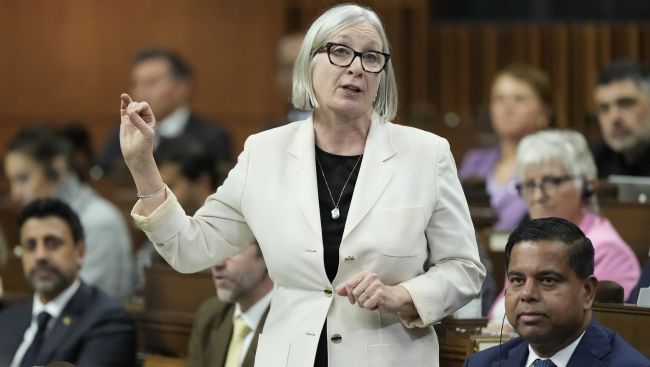
The federal government is launching consultations on ways to improve labour relations to support Canada's economy and communities.
Jobs Minister Patty Hajdu is looking for feedback from employers, unions and employee groups on collective bargaining timelines, training and supports for workers affected by artificial intelligence, and updates to workplace health and safety protections.
She is also seeking input on how to strengthen protections against wage theft, and options to ensure union rights carry over when contracts are re-tendered.
"We need to ensure that we have stronger labour relations across the country for the continuity of business, but also to protect workers," Hajdu said in an interview with The Canadian Press on Friday.
"This is about an earlier, more smooth approach to helping support those better relationships that result in earlier agreements and more stability for workers, more stability for business and, ultimately, the Canadian economy."
Consultations will take place through virtual and in-person roundtables, and written feedback will be accepted until May 18. That feedback will be published in a report that will inform policy decisions, Hajdu's department said.
The consultations come after several high-profile disputes between industry and employee groups in the airline and trucking sectors.
In February, Hajdu's department published the initial findings of a probe launched six months earlier into allegations made during collective bargaining between Air Canada and the union representing its flight attendants.
More than 10,000 Air Canada flight attendants went on strike in August 2025, disrupting travel plans for thousands of passengers.
Central to that labour dispute was a claim made by the Air Canada component of the Canadian Union of Public Employees that flight attendants were not being paid for some work, such as ground duties.
Employers in federally regulated industries like the airline sector must compensate employees at or above the federal minimum wage.
Hajdu's department said it did not find evidence in the first phase of its probe that compensation practices in the airline sector fall short of those standards.
But its report did say that compensation practices for many part-time and entry-level flight attendants warranted "closer examination."
Hajdu said Friday she hopes the new consultations can help address long-standing irritants that tend to turn into roadblocks during negotiations.
"People forget that it's not just employers and unions. It's also the government of Canada that has to have robust tools to help settle grievances, to make sure that we have proactive inspections, that workers feel we're able to protect their rights to safe workplaces and fair practices," Hajdu said.
Consultations on wage theft are directed at the trucking sector, Hajdu said, pointing to disputes between truckers and their employers.
A House of Commons committee began a probe of that sector last October after some transport companies classified drivers as independent contractors instead of employees.
“The unfortunate truth about this scam is that bad actors are not only winning, they are also taking over the industry and the Canadian supply chain,” Canadian Trucking Alliance president and CEO Stephen Laskowski said at an October committee meeting.
Laskowski said these drivers are “virtually indistinguishable” from traditional employees because they don’t own or lease their vehicles and have little to no financial stake in the business. Transport companies can, however, use their status as contractors to deny them benefits.
“The only difference is they are coached, coerced or elect to incorporate themselves in an attempt to masquerade as something other than an employee,” Laskowski said. “For the company, they use this justification to strip workers of all their labour right entitlements.”
Hajdu said this classification scheme can "create really dangerous situations," with people working overtime or in violation of health and safety standards, which she called "abhorrent."
She said consultations could lead to the introduction of legislation, but there is no timeline at this point.
Picture Courtesy: THE CANADIAN PRESS/Adrian Wyld