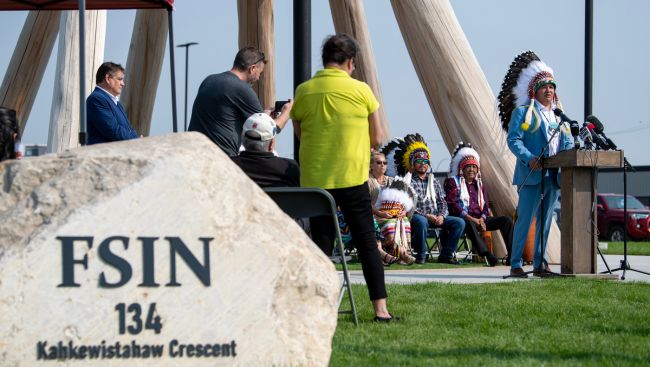
An advocacy group representing First Nations in Saskatchewan is firing back after a forensic audit found more than $34 million in questionable, unsupported or ineligible spending over five years.
The Federation of Sovereign Indigenous Nations responded to the results of a recent forensic audit saying it has a robust system of financial management, accountability and transparency, but that processes during the probe hindered the organization's ability to provide relevant information.
"(The federation) has excellent capacity and record keeping ... unfortunately, due to underfunding, many First Nations and First Nations organizations do not have the level of capacity to respond to such audits," the organization said in a statement released on Wednesday.
"Systemic change is required as transparency and accountability should be a partnership that helps First Nations build capacity - not a series of hoops they must jump through that keep moving and shrinking."
The independent audit, conducted by KPMG on behalf of the federal government, examined funds provided by Indigenous Services Canada to the organization, which represents 74 First Nations in Saskatchewan, between April 2019 and March 2024.
It found that $23 million of the $30 million the organization received for COVID-19-related funding was spent in a way that was "questionable." It also said KPMG couldn't determine if any of the personal protective equipment purchased with the money was distributed to communities the federation represents.
The audit also cited more than $50,000 in "questionable" or "ineligible" travel expenditures, along with another $265,000 in travel spending that KPMG said may have contravened the organization's own travel policies.
KPMG also said there may have been an overpayment among nearly $250,000 in salary and contract payments issued to a former employee, among other charges for vehicles, photocopying, administrative fees, and procurement KPMG found ineligible, questionable or unsupported.
Some First Nations leaders in the province have called for accountability and answers from the organization.
The federation said it hasn't received the full audit report, despite sending multiple requests to Indigenous Services Canada, and isn't able to provide rationale for each finding.
A spokesperson for the department said it has not received a request from the federation for a full copy of the report.
"Consistent with our normal practice, the department does not provide copies of the reports to funding recipients as the information is deemed highly sensitive and may contain protected and/or personal information," said Anispiragas Piragasanathar in a statement.
"The final summary report, which is posted to the department website, provides all publicly available information."
In a 10-page response, the federation did provide a breakdown for the preliminary findings.
"(The federation) categorically rejects the suggestion that purchases under COVID lack documentation. Receipts and/or invoices were provided for every expenditure," it said.
"To dismiss this work as 'questionable' is baseless and disregards the reality that (the federation's) efforts protected elders, children and families."
The organization said some of the First Nations it represents asked the group to co-ordinate distribution of supplies. It agreed and set up warehouses to receive, repackage and distribute protective supplies to First Nations based on a population model. It hired casual workers, drivers and rented trucks to distribute the PPE, as well as relied on volunteers.
The federation said the federal government "insisted" that the funding flow through the organization, which it opposed, arguing individual nations should be supported directly.
The organization noted that some clerical errors led to overpayments that were later corrected, including one that saw the federation's agency get a duplicate payment.
It disputed the audit's findings of questionable travel expenses saying that all employee travel requires prior authorization that must be included along with a brief meeting report when being submitted for reimbursement.
In regards to procurement practices, the organization said each of the expenditures reviewed were supported and consistent with its financial policies and oversight mechanisms.
The group said they were given 10 business days to respond to a list of more than 700 questions and requests for data items, and that, "the nature of the allegations were not shared making it difficult to ascertain what (KPMG) required."
The federation reiterated calls it made decades ago for the creation of a First Nations auditor general.
"The FSIN has faced unwarranted attacks in relation to the forensic audit ... These attacks seem to be fuelled by malicious intentions and have contributed to heightened racial tensions by perpetuating negative stereotypes about First Nations," it said.
Picture Courtesy: THE CANADIAN PRESS/Liam Richards