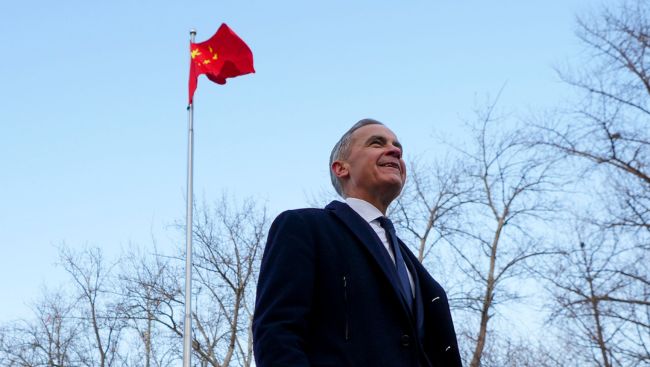
Prime Minister Mark Carney secured what he called a "landmark" deal with Chinese President Xi Jinping in Beijing on Friday, ending a three-day visit aimed at "recalibrating" strained relations between Canada and China.
The "strategic partnership" offers a break on tariffs between the nations and opens up new avenues for trade and co-operation. Carney's comments after signing the deal are also making political waves within Canada and around the world.
Here's what came out of the first visit by a Canadian prime minister to China in eight years.
Canola and electric vehicles
The headline result from Carney's visit was a sharp reduction in China's duties on Canadian agricultural products in exchange for Canada allowing some Chinese electric vehicles into the country.
Ottawa expects Beijing to drop canola seed duties to 15 per cent from 84 per cent by March 1.
Canadian canola meal, lobsters, crabs and peas will no longer be subject to Chinese "anti-discrimination" tariffs from March to at least the end of the year. There was no mention of canola oil, which is subject to a 100 per cent tariff.
In return, up to 49,000 Chinese electric vehicles will be allowed into the Canadian market each year at a 6.1 per cent tariff rate instead of the current 100 per cent tariff.
Carney said he expects this move will drive future Chinese investments into Canada's auto sector within three years.
Canada instituted the tariffs in lockstep with former U.S. president Joe Biden and the European Union back in 2024 to counter China's rapidly growing electric vehicle industry and protect the Canadian auto sector.
Ontario Premier Doug Ford slammed the EV tariff relief in a social media post Friday, saying China now has "a foothold in the Canadian market" that it will use at the expense of Canadian workers.
Increasing exports to China, welcoming Chinese investment
A news release from the Prime Minister's Office says Canada is expecting new deals signed on the trip will help resolve long-standing trade barriers in the agricultural sector, "from beef to pet food" — Canadian exports that have been banned from China for years.
Canada is also setting a goal of increasing its overall exports to China by 50 per cent by 2030.
The PMO says Carney and Xi also spoke about boosting two-way investment in clean energy and technology, agri-food and wood products.
China is Canada's second-largest trading partner. Canadian merchandise exports to China totalled $30 billion in 2024, while imports from China stood at $88.9 billion.
Carney has been working on establishing new export markets for Canadian goods and raw materials since taking office to offset the impact of U.S. President Donald Trump's protectionist policies.
Carney said Friday Canada welcomes Chinese business plans to "significantly scale up their investment" in the country in major clean energy, agriculture and consumer projects. He suggested the strategic partnership would lay the groundwork for future Chinese investments and "opportunities for Canadian workers."
Security concerns
Talk of deeper trade ties comes after years of national security concerns about Chinese technology. Canada banned China's Huawei from working on the country's 5G networks in 2022, citing these concerns.
Federal Conservative Leader Pierre Poilievre said Carney will have to explain how he went from calling China the biggest security threat to Canada during the election campaign to striking a "strategic partnership" with Beijing on Friday.
He also questioned whether tariff reprieves from China will last.
Carney said Friday the security landscape "continues to change." He said Canada will manage the threats of a "more dangerous and divided world" through engagement, building resilience and forging alliances.
"We're pursuing all of those. While the threat environment has increased, the risks have multiplied, so too has our resilience and our engagement," he said.
Visa-free travel and deeper co-operation
Carney and Xi also spoke about advancing cultural ties between Canada and China.
The PMO says Xi committed to "introducing visa-free access for Canadians travelling to China."
The two nations will restart the Canada-China Joint Committee on Culture and Canada will look to attract more Chinese tourism to the country, particularly around this year's FIFA World Cup.
Carney also extended an invitation for Chinese leaders to visit Canada "at a mutually convenient time."
Canada signed a host of memorandums of understanding with China during the trip, and the two sides agreed to work together on issues ranging from cybersecurity to the environment.
'Alignment' on Greenland
Carney told reporters after the signing on Friday there was "much alignment" between himself and Xi on their views about Greenland's sovereignty.
Canada's position is that Greenland, a semi-autonomous territory of Denmark, should determine its own future as the United States makes overtures about taking control of the island for reasons of national security.
Trump also has claimed that if the U.S. doesn't have control of Greenland, Russia or China would try to take it over. Arctic experts say that claim is false.
China, which views itself as a "near-Arctic state," has taken an increasingly aggressive posture in the region that includes joint military exercises with Russia near Canadian territory and around Alaska.
Canada's latest defence policy — released in 2024, before Carney took office — warns of Chinese and Russian ambitions in the Arctic and says China's interests "increasingly diverge from our own on matters of defence and security."
Picture Courtesy: THE CANADIAN PRESS/Sean Kilpatrick