Extreme polarization and consensus are dangerous and a better Canada can only be built through the "peaceful management" of our differences, Gov. Gen. Louise Arbour said Monday, in her first speech as the King's representative in Canada.
The former Supreme Court justice said our ability to coexist peacefully, despite our differences, is critical to maintaining a lawful, rules-based society.
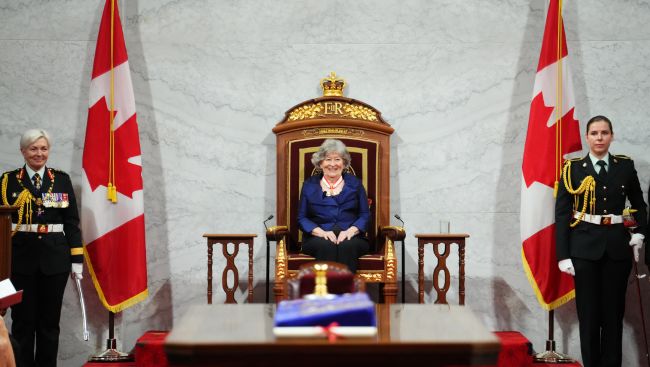
"It is through our differences, and our fundamental right to express them, that we will nourish critical thinking, creativity and innovation," Arbour said from the throne in the Senate chamber.
"It is through our differences that we will build a common future."
Arbour, 79, said it is important to protect institutions where societal debates take place such as universities, the media, courtrooms, legislative spaces and the arts.
By coming together to constructively share thoughts and opinions on our differences, Arbour said a better shared future can be built.
"We do not mistake humility for weakness, nor do we measure a person's worth by the thickness of their wallet. We don't think we are perfect, but we believe we're pretty well on the way there," she joked.
Arbour also discussed the rapid growth of artificial intelligence and cautioned against overreliance on the technology. She said the convenience this technology offers can't lead Canadians to overlook the "profound societal shifts" that are coming.
"With instant access to vast amounts of information, it's very tempting to pay little attention to the reliability of sources. The lines between knowledge and belief, between truth and falsehood, between facts and assumptions are increasingly blurred," Arbour said.
"AI could be threatening not only the way we live and work, but also the control we exercise over our own destiny."
She said this is not an insurmountable challenge, but one that can be met with strong institutions and a private sector that "upholds the standards of integrity that Canadians expect."
She said young Canadians should realize how lucky they are to share this country, even as they're rightfully concerned about the challenges like climate change, wealth inequality and armed conflicts around the world.
The military and governor general share a close connection, and Arbour spoke about the importance of security, especially in the Arctic, as Canada looks to be a "beacon" for a world out at sea.
"We must remain attentive to the rights of those directly affected, and we must always ensure a fair sharing of both burdens and benefits. Our collective security rests above anything else on the trust that we place in each other," Arbour said.
She also thanked outgoing governor general Mary Simon for serving in the role through the COVID-19 pandemic and economic upheaval, and for showing that reconciliation is a lifelong exercise.
Simon received a standing ovation in the Senate.
Rideau Hall issued a statement on behalf of Simon once the ceremony began with an exiting thank you message for Canadians, where she called for continued "building bridges of empathy and connection throughout our vast country."
"I believe in the importance of strengthening relationships and deepening understanding among all peoples, Indigenous and non-Indigenous alike," Simon wrote.
"Reconciliation belongs to all of us. It is not only about acknowledging the past, but also about shaping our shared future. It calls for us to share our stories, to learn from one another, and sometimes to have difficult but necessary conversations. This is how we move forward together, in dignity and equality.
The official duties of a governor general include serving as commander-in-chief of Canada — which includes awarding military honours — swearing cabinet ministers into office, proroguing and dissolving Parliament, making appointments on the prime minister's advice and granting Royal Assent to turn bills into law.
Arbour was welcomed at the Senate of Canada building on a sunny Monday morning by Simon, Prime Minister Mark Carney, his wife Diana Fox, Usher of the Black Rod Greg Peters and other dignitaries.
An Algonquin elder read a territorial welcome for Arbour and the assembled dignitaries before they entered the Senate building.
Canada's treaties are agreements signed between First Nations and the Crown, making the relationship between Indigenous peoples and the monarch an important part of the installation ceremony.
Chief Justice Richard Wagner read out the oaths that Arbour had to take to become governor general just before 10:30 a.m. EDT.
The event included a performance by francophone artist Sara Dufour, who sang "La Reine" by Les Cowboys Fringants. The song is about a woman who puts her service to others ahead of her own personal challenges. Anglophone artist Tyler Shaw performed "Like Me and You" by Raffi at the ceremony.
Chimwemwe Undi, Parliament's poet laureate, read her poem "Reasons," which she wrote for the ceremony. A French translation of the poem was read aloud by a student from the Louise Arbour Elementary School in Ottawa.
A 21-gun salute was fired from canons set up nearby on Parliament Hill as Arbour ascended the throne of the Senate to become the King's representative.
The Central Band of the Canadian Armed Forces played "God Save the King" and the Governor General's Flag was raised on the Peace Tower to mark the moment Canada received its new viceregal.
Arbour had a distinguished legal career and served as chief prosecutor for the International Criminal Tribunals of the former Yugoslavia and Rwanda. She made history when she became the first to indict a sitting head of state — Serbia's president Slobodan Milosevic — for crimes against humanity.
The Montreal native also secured the first conviction for genocide since the establishment of the 1948 Genocide Convention in the case of a former Rwandan mayor.
King Charles approved Arbour's appointment, the first since he took the throne in 2022.
Arbour met with King Charles at Buckingham Palace last week.
Picture Courtesy: THE CANADIAN PRESS/Sean Kilpatrick