AUCKLAND, New Zealand — On the eve of a G20 summit in Australia expected to focus in part on the crisis in Syria and Iraq, Stephen Harper says Canada does not support war on the Syrian government or any Middle East nation — only war against the Islamic State.
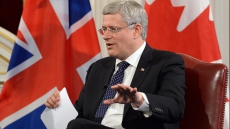
"The government of Canada is prepared to engage in actions against ISIL in Syria but only as long as those are not interpreted as war against the government of Syria," the prime minister told a news conference Friday at the end of his first official visit to New Zealand.
"Whatever objections the government of Canada has against the government of Syria, we are not interested in any war against any government in the region — our only military fight is with ISIL."
Harper spoke a few hours after a military official revealed that Canadian warplanes have destroyed only two Islamic State targets in nearly two weeks of air operations.
The mission commander said success can't be measured in the number of bombs dropped, because the air campaign is putting the Islamic State of Iraq and the Levant on the defensive.
U.S. President Barack Obama, meantime, has reportedly developed a new strategy to defeat the al Qaida splinter group — starting with the removal of Syrian President Bashar al-Assad. The Americans believe Assad is the reason ISIL have been able to gain strength in Syria.
Harper pointed out that his government has long called for the resignation of the Syrian leader.
But he added that the government believes that "the only way we can get a solution in Syria is some kind of political compromise between moderate elements of the opposition as well as the moderate elements of the government."
"We don't think it's possible to bring the diverse elements of Syria together unless you have both sides come together in some way, that a victory of one side over the other is just not a realistic or desirable outcome."
Nonetheless, he added, the fight has to be taken against ISIL and other extremists that threaten Canada and other western countries.
The prime minister was also asked about the major U.S.-China climate deal announced earlier this week.
Under that agreement, the United States vowed to double the annual rate at which it is reducing its emissions and, by 2025, cut emissions to 26 to 28 per cent below 2005 levels.
China, meanwhile, said 20 per cent of its energy would come from zero-emission sources by 2030, the year the country has promised its greenhouse gas emissions will peak. It was the first time China has agreed to cap emissions.
Canada has long said it would match U.S. actions on climate change and Harper was asked when Canada would match the more ambitious greenhouse gas emission targets contained in that landmark agreement.
He didn't answer the question directly, instead praising the deal and citing Canada's accomplishments on climate.
"We have been saying that we favour an international agreement that will include the major emitters," he said, pointing out that China and the U.S. are the No. 1 and No. 2 GHG emitters in the world.
Harper said Canada is already ahead of the United States when it comes to curbing greenhouse gas emissions.
‘‘We've done our own electricity sector regulations, which are well ahead of the United States. We have the cleanest electrical sector in the world and it will be even more clean in the years to come as a consequence of regulations we brought in on coal."
Harper added that the U.S.-China deal shouldn't have any impact on the fate of the long-delayed Keystone XL pipeline.
The news conference marked the end of Harper's visit to New Zealand. He arrived late Friday in Brisbane for the G20 summit, one that Australian Prime Minister Tony Abbott has said will have a heavy economic focus.
The prime minister's day in Auckland involved rubbing noses with Maori ceremonial warriors as well as laying a wreath at the Auckland war memorial.
Harper and New Zealand Prime Minister John Key reflected on their close ties during the news conference.
Key laughingly praised the Canadian flag, saying he is running a "successful" campaign to change the New Zealand flag to one that is more recognizably Kiwi.
He has frequently pointed to Canada's switch to its famous Maple Leaf flag in 1965 as evidence that it won't dishonour New Zealand's war dead by having a new ensign.