Thursday, July 2, 2026
ADVT 
National

How it started, how it ended: A chronology of Ontario's ad blitz against U.S. tariffs

Darpan News Desk The Canadian Press, 03 Nov, 2025 02:14 PM
  • How it started, how it ended: A chronology of Ontario's ad blitz against U.S. tariffs

Here is a day-by-day chronology of the controversy over Ontario's advertising campaign against U.S. tariffs on Canadian goods:

Tues., Oct. 14: The office of Ontario Premier Doug Ford says the province will spend $75 million to broadcast an anti-tariff ad in the United States using video of an address by former U.S. president Ronald Reagan, who said in 1987 that in the long run, "such trade barriers hurt every American worker and consumer."

Tues., Oct. 21: A day after the ad airs during a broadcast of a baseball playoff game won by the Toronto Blue Jays, U.S. President Donald Trump says he saw the commercial, adding "if I was Canada I'd take that same ad also."

Thu., Oct. 23: The Ronald Reagan Presidential Foundation and Institute says the ad misrepresents Reagan's remarks and that Ontario did not seek or receive permission to "use and edit the remarks."

Trump says he is ending trade negotiations with Canada over the commercial.

The ad isn't a "fake" as Trump claims, but Reagan's quotes are spliced together from different sections of the original speech. 

Ford's office defends the ad.

Fri., Oct. 24: Trump accuses Canada of "cheating" by saying that Reagan did not like tariffs, which Trump claims the late president "loved."

David McLaughlin and Geoff Norquay, who worked as senior policy advisers for former prime minister Brian Mulroney, say the ad did not misconstrue Reagan's views on trade.

Ford says his government will pull the ad after the weekend, though it's still set to run during the first two games of the World Series.

Manitoba Premier Wab Kinew encourages Ford to keep the ad campaign going, saying Trump's tariffs betray Reagan's legacy.

Sat., Oct. 25: Trump says the U.S. will impose an additional 10 per cent tariff on Canadian goods because Ontario didn't immediately pull down the ad.

Mon., Oct. 27: Ford vows he will "never apologize" for pushing back against hostile trade measures designed to poach jobs from his province.

Fri., Oct. 31: Trump says Prime Minister Mark Carney apologized for the ad but the U.S. president adds that trade talks are not resuming.

Sat., Nov. 1: Carney confirms he apologized to Trump and says he told Ford he didn't think the province should run the ad campaign. 

Sun., Nov. 2: U.S. Treasury Secretary Scott Bessent says the ad amounted to foreign interference in American public policy.

Mon., Nov. 3: Ford says Carney called him "a couple of times" from a trip to Asia to ask him to pull the ad campaign.

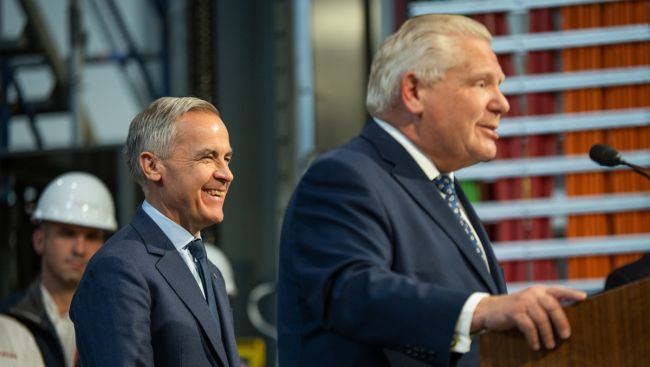
Picture Courtesy:  THE CANADIAN PRESS/Laura Proctor

MORE National ARTICLES

Canadians should expect AI-enabled foreign meddling in election: cybersecurity centre

Canadians should expect AI-enabled foreign meddling in election: cybersecurity centre
In a new report, the Canadian Centre for Cyber Security says it expects individuals affiliated with the Chinese government will continue to target diaspora communities, pushing narratives favourable to Beijing's interests on social media platforms. Cybercriminals are also likely to take advantage of election-related opportunities to perpetrate scams, says the centre, which is an arm of Canada's cyberspy agency, the Communications Security Establishment. 

Canadians should expect AI-enabled foreign meddling in election: cybersecurity centre

B.C. to get about $3.7 billion in tobacco lawsuit settlement

B.C. to get about $3.7 billion in tobacco lawsuit settlement
British Columbia Attorney General Niki Sharma says B.C.'s share of a landmark settlement for health damages from the big tobacco firms will be about $3.7 billion. It's part of a $32.5-billion Canadian settlement between JTI-Macdonald Corp., Rothmans, Benson & Hedges and Imperial Tobacco Canada Ltd. and their creditors after more than five years of negotiations.

B.C. to get about $3.7 billion in tobacco lawsuit settlement

B.C. poised to toll U.S. trucks driving to Alaska through province in tariff response

B.C. poised to toll U.S. trucks driving to Alaska through province in tariff response
British Columbia will introduce legislation in the coming days that would give it the ability to levy fees on commercial trucks travelling from the United States through the province to Alaska, Premier David Eby said.  The move against Alaska-bound trucks is part of a series of responses the province is planning after the "unprecedented attack" from the United States that put a 25 per cent tariff on many Canadian goods.

B.C. poised to toll U.S. trucks driving to Alaska through province in tariff response

Canada halts second tariff wave after Trump announces pause

Canada halts second tariff wave after Trump announces pause
Finance Minister Dominic LeBlanc says Canada has suspended a second wave of retaliatory tariffs after U.S. President Donald Trump signed an executive order to pause some duties.

Canada halts second tariff wave after Trump announces pause

Former Canadian Olympic athlete added to FBI's 10 most wanted fugitives list

Former Canadian Olympic athlete added to FBI's 10 most wanted fugitives list
Ryan James Wedding is wanted for allegedly leading an organized crime group that moved large shipments of cocaine from Colombia through Mexico and California to Canada and other locations in the United States.

Former Canadian Olympic athlete added to FBI's 10 most wanted fugitives list

Shots over the bow: Why provinces are using liquor leverage in trade war with U.S.

Shots over the bow: Why provinces are using liquor leverage in trade war with U.S.
What they all have in common is the "currently unavailable" designation, having been yanked from sale by British Columbia's government in retaliation for U.S. President Donald Trump's tariffs on Canadian imports. Calling time on U.S. alcohol has been a popular move among Canadian provincial and territorial governments looking for ways to fight back in the trade war. 

Shots over the bow: Why provinces are using liquor leverage in trade war with U.S.