Tuesday, June 9, 2026
ADVT 
National

Human activities linked to orca deaths: study

Darpan News Desk The Canadian Press, 02 Dec, 2020 09:59 PM
  • Human activities linked to orca deaths: study

A long-running study of more than 50 dead killer whales in the Pacific Ocean concludes human activities pose deadly threats to the orcas.

Killer whale deaths from Alaska to British Columbia, south to California and west to Hawaii linked to human activities were found in every age class from calves to adults, said the study published Wednesday in the open access journal Plos One.

The findings indicate that understanding and being aware of each threat is vital for the management and conservation of orca populations, said Stephen Raverty, a B.C. scientist and the report's lead author.

Some of the direct causes of orca deaths were attributed to blunt force trauma from collisions with ships or cuts from the propellers of vessels, while indirect causes were related to ingested fish hooks, various human-caused pollutants and malnutrition, Raverty said in an interview.

"In one case in Alaska, a young animal swallowed a hook that perforated the back of the throat and resulted in bacteria entering the body and the animal died of a blood-borne bacteria infection," he said.

In another necropsy conducted on an older orca, a triple-barbed fishing hook was found in the animal's colon, but it did not appear to impact its health, Raverty said.

Raverty, who's a veterinary pathologist at the B.C. Agriculture Ministry and a marine mammal researcher, said the study also provides a baseline understanding of orca health necessary for future research.

"There have been a variety of indirect things that have been demonstrated to impact killer whale health and what we're saying is this is more direct evidence of human activities that impact the overall well-being of these animals," he said.

The study involved necropsies on the remains of 53 killer whales foundfrom the North Pacific to Hawaii from 2004 to 2013. It also examined the data from 35 other orca deaths from 2001 to 2017, said Raverty.

The study was able to confirm the cause of death in 22 of the 53 orcas, and "death related to human interaction was found in every age class."

It said necropsies showed evidence of 15 infectious agents and 28 pathogens with the potential to affect orca health, but "non-infectious health concerns include impacts from accumulated persistent pollutants, human interactions including vessel collisions, interaction with fishing gear, the effects of noise and consequences of reduced prey availability."

Raverty said the study's results should support federal government efforts to reduce and slow down shipping traffic and noise pollution to protect threatened orca populations, including the West Coast's southern residents that now number 73 members.

The federal government recently expanded orders for B.C. whale-watching vessels, requiring them to stay 400 metres away from orcas on their viewing voyages.

"You think of these animals as being very agile and being able to avoid impact with vessels, but that doesn't appear to necessarily be the case," Raverty said. "Whether it's just the vessel's speed or there's increased shipping traffic or these vessels are going into some fairly narrow channels where whales may not be able to avoid or evade these vessels, these might be some of the conditions that are occurring."


MORE National ARTICLES

Huge job losses in B.C. indicate a 'hard road ahead': finance minister

Huge job losses in B.C. indicate a 'hard road ahead': finance minister
British Columbia Finance Minister Carole James says she doesn't want to sugar coat what will be a hard road ahead as labour force figures show the province lost a quarter of a million jobs in April. Combined with jobless figures in March, almost 400,000 people were unemployed.

Huge job losses in B.C. indicate a 'hard road ahead': finance minister

Canadians trust doctors, scientists and government more since pandemic began

Canadians trust doctors, scientists and government more since pandemic began
A new survey suggests the COVID-19 pandemic has given Canadians almost absolute trust in doctors. The Proof Strategies annual trust index is usually completed in January but when Canada went into a nationwide lockdown to slow the spread of the novel coronavirus the public-relations firm decided to ask the same questions again in early May.    

Canadians trust doctors, scientists and government more since pandemic began

Greyhound Canada to shut down temporarily all bus routes as ridership plunges

Greyhound Canada to shut down temporarily all bus routes as ridership plunges
Greyhound Canada is temporarily slamming the brakes on all of its bus routes and services as ridership plummets amid the COVID-19 pandemic. The transportation company says starting May 13 it will halt all routes until passenger demand recovers. 

Greyhound Canada to shut down temporarily all bus routes as ridership plunges

Canadian Forces still unsure how to raise helicopter that crashed

Canadian Forces still unsure how to raise helicopter that crashed
The Canadian military is still determining how to raise the wreckage of a military helicopter that crashed into the Mediterranean Sea last week, Defence Minister Harjit Sajjan said Thursday. The crash killed six members of the Canadian Forces, though the remains of only one, Sub-Lt. Abbigail Cowbrough, have been recovered.

Canadian Forces still unsure how to raise helicopter that crashed

Feds to partly cover 'top ups' for front-line workers on minimum wage

Feds to partly cover 'top ups' for front-line workers on minimum wage
Prime Minister Justin Trudeau says the federal government, provinces and territories will spend $4 billion to increase the wages of essential workers in the COVID-19 pandemic. He says the details are still to be finalized with some provinces.  

Feds to partly cover 'top ups' for front-line workers on minimum wage

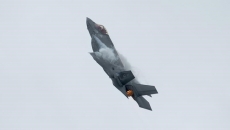
The federal government has made another multimillion-dollar investment into the development of the F-35 stealth fighter despite no guarantee it will buy the aircraft.

The federal government has made another multimillion-dollar investment into the development of the F-35 stealth fighter despite no guarantee it will buy the aircraft.
The federal government has extended the $19-billion competition to replace Canada's aging CF-18s by another month because of COVID-19 — one week after it made another multimillion-dollar investment into the development of the F-35 stealth fighter jet.

The federal government has made another multimillion-dollar investment into the development of the F-35 stealth fighter despite no guarantee it will buy the aircraft.