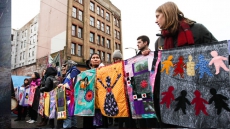
VANCOUVER - Countless treasured Indigenous cultural objects and ancestral remains are held by museums in Canada and across the world, and local communities and human rights experts say it's time they are returned according to the United Nations Declaration on the Rights of Indigenous Peoples.
"All of the things that would have been interwoven prior to contact and just part of everyday life were torn apart and cast in a thousand directions," says Lou-ann Neel, a Kwakwaka'wakw artist and repatriation specialist at the Royal B.C. Museum in Victoria.
A blanket created by Neel's grandmother is held at that museum, she added.
"On the one hand (it's) really exciting to find these things, but it still breaks your heart to realize that we've had probably five or six generations that have been without," she said, noting that repatriation is crucial to healing and fostering people's sense of identity.
It's common for museums to display fractions of their collections, Neel said, and many treasures won't ever see the light of day.
"What's the point in that?" she asked. "Especially when people can grow and thrive and celebrate and give expression to their living cultures now."
Neel is among a group of international experts and United Nations officials who gathered for a two-day seminar focused on the repatriation of artifacts and ancestral remains at the University of British Columbia this week.
In particular, the seminar explored how repatriation could work under the United Nations Declaration on the Rights of Indigenous Peoples, which asserts the rights of Indigenous Peoples to practice their cultural and spiritual traditions, and to control their ceremonial items and ancestral remains.
It also recognizes that governments should help facilitate repatriation and provide restitution in consultation with Indigenous communities.
The B.C. government passed legislation in November to facilitate the implementation of the declaration in the province.
Vince Collison has been working to repatriate treasures and ancestral remains since the late 1980s as a member of the Haida Gwaii repatriation committee.
"The challenge I want to give to every one of those museums is 'You thought well enough of us to collect us. Think well enough to help send some things back to a community that really needs it more than you do,' " said Collison, who also attended the seminar.
"Those things mean way more to us than anybody else in the world," he said, adding that Haida language and context for each stolen treasure was stripped away and repatriation involves the restoration of their rightful meaning.
The Royal B.C. Museum held more than 1,400 ancestors and about half of those have returned home since 2016, said Neel. It still holds about 15,000 treasured objects and artworks.
The remains of about 500 Haida ancestors have also been repatriated over the last 20 years, said Collison.
The Royal B.C. Museum changed its policies last year and will no longer collect or study ancestral remains. Anything it acquired under duress and anything acquired between 1885 and 1951, when the Canadian government enforced the potlatch ban, would also be eligible for repatriation. The museum does not collect items that lack provenance, or paperwork, indicating their origins, Neel added.
In partnership with the Haida Gwaii Museum, the Royal B.C. Museum also published an Indigenous repatriation handbook that serves as a reference for museums and Indigenous communities in B.C. last year.
It drew international attention said Neel, though some museums remain "drenched in the colonial mindset" that Indigenous Peoples don't know how to take care of their own possessions.
Indeed, the most frequently asked question Neel hears is whether a community would be required to build a museum in order to preserve repatriated items.
"For the Royal B.C. Museum the answer is, it's none of our business. These are your cultural treasures," she said, adding that communities often want to build appropriate local facilities.
Royal B.C. Museum policies preclude the repatriation of treasures and ancestors into the care of an individual. Rather, they must be returned to an entity, such as a band council or a cultural centre, said Neel.
Repatriation is also costly, Neel and Collison said, and the onus is mostly on communities to come up with the necessary funding.
National Chief Perry Bellegarde of the Assembly of First Nations told the seminar he believes the federal and provincial governments are obligated to help identify the resources communities will need to make repatriation a reality.
Once treasures and ancestors are returned, Neel said she believes in the potential for museums to facilitate meaningful cross-cultural experiences.
The museum of the future will be more interactive and reflective of the people and land around it, she said, suggesting there could be opportunities to meet people first hand, rather than peering at poorly labelled artifacts through glass.