The author of a damning report that found widespread racism in British Columbia's health system has released the results of surveys and data collection, revealing a massive gulf between the experiences of Indigenous and non-Indigenous patients.
Mary Ellen Turpel-Lafond released a supplemental data report Thursday that shows Indigenous people in B.C. are much more likely to feel unsafe in health-care settings, that they are never included in care decisions and they receive poorer service than others.
Join Adrian Dix, Minister of Health, and Mary Ellen Turpel-Lafond, for an update on the In Plain Sight report. https://t.co/kH4cMGRhSa
— BC Government News (@BCGovNews) February 4, 2021
"Taken together, these ... reports clearly demonstrate the need for immediate, principled and comprehensive efforts to eliminate all forms of prejudice and discrimination against Indigenous Peoples in the B.C. health-care system," she writes in the new document.
The report comes as Indigenous people across B.C. are speaking out, including the Nuxalk Nation in Bella Coola where hundreds of COVID-19 vaccine doses were abruptly withdrawn and a woman in Kitimat whose baby was stillborn after she says a hospital turned her away.
Turpel-Lafond, a former judge and ex-children's advocate, was appointed by Health Minister Adrian Dix last year to examine anti-Indigenous racism in health care. Her first report came out in November and made 24 recommendations.
Dix said at the time his government would implement the recommendations, which included the creation of an Indigenous health officer and an associate deputy minister of Indigenous health.
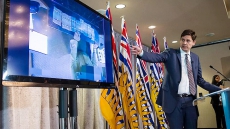
Turpel-Lafond and Dix held a news conference Thursday to release her supplemental report, which is based on results of surveys, submissions to her team and patient complaints, as well as hard data on how Indigenous people use health care and the outcomes they experience.
Almost 9,000 people directly shared their perspectives through surveys and submissions, while approximately 185,000 Indigenous individuals are reflected in the health sector data.
Indigenous survey respondents were significantly more likely to feel unsafe in health facilities. For example, in emergency rooms, 16 per cent felt "not at all safe" and 57 per cent felt "somewhat unsafe," compared with five and 38 per cent of non-Indigenous people, respectively.
Twenty-three per cent of Indigenous respondents reported they "always" received poorer service than others, with 24 per cent treated as though they were dishonest, 26 per cent treated as if they are drunk or asked about substance abuse and 14 per cent treated like bad parents.
Some 67 per cent of Indigenous respondents reported they had experienced discrimination from health-care staff based on ancestry, compared to five per cent of non-Indigenous respondents.
In fact, only 16 per cent of all Indigenous respondents reported never having been discriminated against for any reason listed while receiving health care.
Turpel-Lafond's team also conducted a survey of health-care workers, of which 35 per cent said they had witnessed racism or discrimination directed to Indigenous patients, family or friends. The number increased to 59 per cent for Indigenous health-care workers who responded.
The report also examined health-care data in the province and found Indigenous people have insufficient access to primary care and preventive care, and increased reliance on emergency departments as well as a higher rate of avoidable hospitalization.
Throughout the report, Turpel-Lafond stresses that Indigenous women are at a particular disadvantage.
"Indigenous women experience unique forms of racism within the health-care system and feel unsafe interacting with that system, resulting in less trust — and therefore avoidance of — discretionary health-care services," resulting in health outcome disparities, she says.
Turpel-Lafond calls on the government to collect system-wide data and monitor indicators including attachment to primary care physicians, use of emergency departments, chronic conditions and maternal and infant health.
The B.C. government has recently faced questioning over two separate incidents involving Indigenous Peoples’ experiences in health care.
As was first reported by the CBC, Nuxalk Nation director of health Kirsten Milton said the community in Bella Coola was set to receive about 110 doses of vaccine, but Vancouver Coastal Health arrived a day early with hundreds of extra doses it said could be given to members.
Milton told The Canadian Press her team administered about 80 shots on the first day of a vaccine clinic and spent the next day uploading necessary data about the people who received shots, a process that was drawn out due to the remote area's spotty internet access.
She said the following evening, she received an email from VCH medical health officer Dr. John Harding saying the authority's chief medical health officer, Dr. Patricia Daly, was disappointed no shots were given out the previous day. He said the First Nation must come up with a distribution plan for 70 shots by 10 a.m. the next morning or the vaccine will no longer be available
Milton said she scrambled to respond, but Harding replied later that day saying his deadline was not met and the “gift” of the vaccines was being withdrawn.
Milton provided the emails to The Canadian Press.
She also said Harding called the RCMP to escort him out of the community.
The RCMP said it was called on Jan. 22 to "keep the peace."
Harding did not immediately respond to requests for comment, but Vancouver Coastal Health board chair Dr. Penny Ballem apologized in a statement, saying she regrets that it failed to provide a culturally safe and respectful experience for Nuxalk Nation members.
The B.C. Health Ministry confirmed that Harding removed 230 doses from the community and said they were used in St. Paul’s Hospital, the site of an outbreak in downtown Vancouver.
Dix and provincial health officer Dr. Bonnie Henry also apologized in a joint statement, adding that they have asked the deputy provincial health officer of Indigenous health to work with the Nuxalk Nation to repair trust.
In a separate incident, the uncle of an Indigenous woman said she was turned away from a Kitimat hospital when she was two weeks overdue to give birth and having contractions.
He said her father drove her to another hospital 45 minutes away in Terrace, where she gave birth to a stillborn baby.
In Ottawa, Indigenous Services Minister Marc Miller announced Thursday the federal government has launched consultations on a law meant to ensure Indigenous Peoples' control over their health services and eliminate racism in health care.