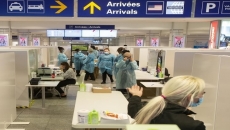
Medical professionals and industry groups are calling on Ottawa to end all COVID-19 border testing requirements as the travel sector struggles to recover two years into the pandemic.
Rule changes, including removal of the requirement that fully vaccinated Canadian travellers take a pre-departure COVID-19 molecular test, took effect Monday.
Rapid antigen tests administered by a health professional remain mandatory for foreign visitors, and for Canadians who want to avoid quarantining at home for 10 days upon return.
At a Monday news conference at the Calgary airport hosted by the Canadian Travel and Tourism Roundtable, WestJet communications vice-president Richard Bartrem said the carrier's flight volume remains at half of its 2019 level of roughly 700 trips per day.
"Fully vaccinated Canadians and inbound visitors should no longer be subject to out-of-pocket testing expenses and outdated measures when returning home," he said.
Dr. Zain Chagla, an infectious diseases physician at St. Joseph's hospital in Hamilton and an associate professor at McMaster University, said that "we really aren't achieving much with what we're throwing at the border other than increasing the inconvenience of the traveller."
"Every variant of concern has made it into Canada and the likelihood of someone acquiring COVID in Canada is not from travel but it is from our day-to-day lives," he said.
Chagla noted that settings ranging from sports arenas to bars and nightclubs do not require a COVID-19 test.
European countries such as the United Kingdom, Denmark and Switzerland have dropped border testing requirements while continuing to surveil for variants in the community via local testing and genome sequencing.
The cost and lower accuracy of rapid tests, which are nonetheless potentially cheaper and easier to access than molecular tests, are another concern.
"We know rapid tests in the era of Omicron are lower sensitivity ... Random individuals are less likely to be positive unless they have symptoms that have been ongoing for some time," Chagla said.
Rapid tests must be taken the day before a scheduled flight or arrival at the land border.
"The likelihood of picking up a positive case is like finding a needle in a haystack. But the costs are not negligible, right? People are still paying $20 to $50 for these tests, so for a family of four it's an extra few hundred dollars into testing," he added.
The federal government announced earlier this month that as of Feb. 28 double-vaccinated air and land travellers no longer need to present a negative result from a molecular test, such as a PCR test, before departure for Canada. They now have the option of a rapid test or a molecular test, the latter taken up to 72 hours beforehand.
Unvaccinated children under 12 are also free of mandatory self-isolation upon return to the country. And Ottawa has lifted its blanket advisory against trips abroad, removing a travel insurance obstacle as well as a mental hurdle for many would-be vacationers on the verge of spring break.
However, random PCR screening of travellers after they arrive at airports or land crossings continues, with test recipients required to self-quarantine until the results come in.
Travel measures triggered by the pandemic have devastated the transport and hospitality sectors, bleeding billions of dollars from Canada's airline sector and shuttering hotels periodically in a whiplash of stop-and-go restrictions.
Wendy Paradis, president of the Association of Canadian Travel Agencies, said in an interview that rapid tests remain an "unnecessary barrier" to family and business travel.
"Trying to get testing in a foreign country can be difficult," she noted, saying the threat of a false positive — and extra days stuck abroad — marks another worry for working families and time-deficient business travellers.
Lesley Keyter, founder of the Calgary-based Travel Lady Agency, is asking the federal government to extend wage and rent subsidy program for tourism and hospitality past March 12.
The country logged a record 96.8 million international arrivals — non-residents as well as returning Canadians — in 2019, according to Statistics Canada. The number dropped to 25.9 million in 2020 and 18.8 million in 2021, though it began to recover later in the year, just before the Omicron variant took its toll.