MANILA, Philippines — The front-page headline that Prime Minister Justin Trudeau awoke to on Friday in Manila before his return to Canada wasn't as fawning as others about him in the Philippines.
"Apec hottie not so hot on taking back Canadian trash in Tarlac," said the tiny story in a corner of page one of the Philippine Daily Inquirer.
Two days earlier, photos of him and a winking Mexican President Enrique Pena Nieto declaring them "APEC hotties" occupied the top half of the paper's front page.
That abrupt shift illustrated the dynamic at play during the prime minister's first week of foreign travel: for every sunny moment celebrating his fresh-faced debut on the international stage, there lay a complex foreign policy pitfall lurking in the shadows.
On his first week of travels — to the G20 in Turkey and the Asia Pacific Economic Co-operation summit in the Philippines — Trudeau's footing stayed sure for the most part, but he faces a challenging path moving forward.
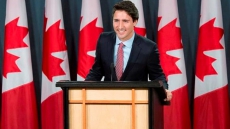
On the issue of the "Canadian trash," Trudeau faced sharp questions from a Filipino reporter near the end of his lengthy and packed APEC press conference Thursday.
Trudeau had evidently digested his pre-trip briefing of hot local issues. The irritant of foreign garbage in the Philippines certainly qualifies, since ships laden with foreign waste have been arriving in the Philippines for about a decade and a half.
In 2013, an Ontario company shipped 50 containers of waste, weighing 2,500 tonnes, through Vancouver, declaring it as scrap metal for recycling. It was later found to be rotting kitchen waste, including used adult diapers.
There have been demonstrations at the Canadian embassy in the Philippines and calls for the garbage to be sent home.
In response to the reporter's question, Trudeau said Canada was working on legislation that would give it some recourse to take action against companies.
"I know that this has exposed a problem that needs fixing within our own legislation," Trudeau said, before the journalist pushed for more.
"I believe there are loopholes here that were allowed to be skirted that we need to make sure we close, both for Canada's interests and a good relationships with our neighbours," the prime minister replied.
On the front-line international issues that he faced going into the trip — Canada's decision to withdraw fighter jets from the combat mission against ISIL, its plan to admit 25,000 Syrian refugees by the year end, and need for further study of the Trans-Pacific Partnership — Trudeau held steady to his core positions.
Repeatedly, Trudeau explained this past week that these were promises that he made to get elected, which were based on listening to Canadians.
That sparked partisan political attacks back home that he wasn't being nimble enough in reacting to the Paris terrorist attacks that unfolded just as he was preparing to fly out of Ottawa last week.
Some analysts say Trudeau's first foreign policy steps have been a bit too rigid, especially in light of the Paris attacks.
"The prime minister's response to the crisis has been to lash himself to the mast of his election commitments on refugees and to withdraw our CF-18s from the allied bombing campaign," said Fen Hampson, director of the global security program at the Centre for International Governance Innovation.
"We are already seeing that soft power, not hard power, will define Mr. Trudeau's global security policies and international engagements."
At the moment, it's an open question whether Trudeau struck the right balance in the face of renewed threats to Western countries, Hampson said.
One of Trudeau's trump cards coming into these two summits was the legacy of his father, Pierre. Earlier in Turkey, China's President Xi Jinping told Trudeau his father had exhibited "extraordinary political vision" in establishing relations with his country, and he wanted to move them forward.
South Korean President Park Geun-hye was effusive in her meeting with Trudeau at APEC saying she hoped Trudeau — like his father —would succeed in "achieving real change" in Canada's foreign policy.
Pierre Trudeau "spent a great deal of energy strengthening and enhancing Canada's relationship with Asian countries and likewise I do trust that you will serve the cause of peace and prosperity in the Asia Pacific as well," Park told the prime minister.
Hampson said the legacy of Trudeau's father set the tone of his first meetings with leaders from Asia, a region the prime minister has placed particular economic emphasis on.
"If this translates into a deeper engagement and reorientation towards the Asia-Pacific, this will be all for the good at a time when Canada must tap into these markets for its future growth and prosperity," said Hampson.
But first, Hampson said Trudeau's new government must firmly commit itself to the TPP — a view shared by many others, including U.S. President Barack Obama and the Canadian Chamber of Commerce.
"Right now, that is the only game in town."
As for Canada's top bilateral relationship with the United States, Trudeau's meeting with Obama unfolded smoothly despite some recent disagreement on the ill-fated Keystone XL pipeline.
Obama extended a warm invitation to the White House to Trudeau and his wife. "Across the board," the president said, "our interests align."