
Thursday, June 25, 2026
ADVT 
National

Last spring forward for B.C. as it moves to permanent daylight time

Darpan News Desk The Canadian Press, 02 Mar, 2026 03:55 PM
  • Last spring forward for B.C. as it moves to permanent daylight time

British Columbia's major southern population centres will be facing winter sunrises around 9 a.m. — and around 9:30 a.m. in the north — after the decision to adopt year-round daylight time, springing forward by one hour this Sunday for the last time.

Premier David Eby said Monday the decision is about making life easier for families, reducing disruptions for businesses and supporting a stable, thriving economy.

"British Columbians have been clear that seasonal time changes do not work for them,” Eby said. 

B.C.'s transition to the Pacific time zone — as opposed to the current Pacific standard and Pacific daylight zones — will put it in the same time zone as the Yukon. It will match Alberta from November to March.

The province will align with California, Washington, and Oregon from March to November, but be an hour ahead outside those months.

The change means that on the shortest day of the year, Dec. 21, the sun will not rise in Victoria until 9:03 a.m. In Prince George, the winter solstice sunrise will be at 9:28 a.m.

Eby says people and businesses will have eight months to prepare for the elimination of the next time change, which had been set for Nov. 1.

He said he’s hopeful B.C.’s American neighbours will join the province in ending the disruptive time changes. 

Attorney General Niki Sharma said they've heard from an overwhelming majority of people in B.C. who want to end the back-and-forth of seasonal time changes.

“This shift offers more stability, supports public well-being and reduces twice-yearly, unnecessary disruptions to the routines of parents, shift workers, small businesses, pet owners and so many more," Sharma said. 

She said she looks forward to enjoying an extra hour of sunlight after work and school for many winters to come. 

The pending change fulfils a promise first made in 2019, when Eby, then attorney general, tabled legislation to make daylight time permanent to end the practice of changing clocks twice a year.

But B.C. conditioned that change on Washington State, Oregon and California also making the switch, which has not happened because the relevant legislation remains in Congressional limbo.

"The situation on the ground has changed since 2019," Eby said, when asked about government's decision to move ahead without waiting on the U.S. states.

"We are able to be a little bit more selfish in our decisions for what is best for British Columbians. It's clear that British Columbians know what is best for them. They want to have that extra hour of sunlight at the end of the day."

Parts of the business community, however, are criticizing the change. 

Bridgitte Anderson, president and CEO of the Greater Vancouver Board of Trade, said government's "unilateral change" marks an "unwelcome distraction that will make it more difficult to attract and retain businesses" in British Columbia.

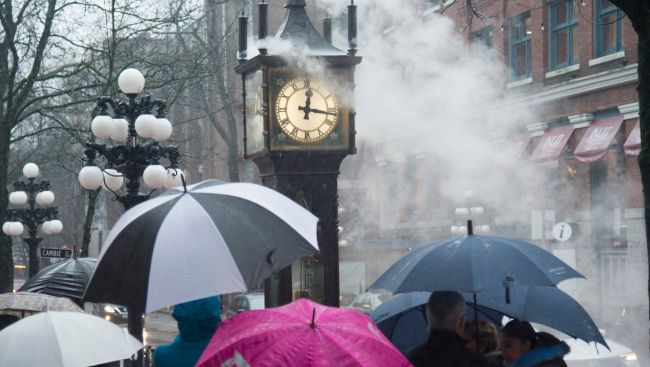
Picture Courtesy: THE CANADIAN PRESS/Jonathan Hayward

MORE National ARTICLES

B.C. farmers challenge government order to cull ostrich herd over avian flu outbreak

B.C. farmers challenge government order to cull ostrich herd over avian flu outbreak
British Columbia ostrich farmers ordered to cull a herd of 400 due to an avian flu outbreak are holding onto hope that the Canadian Food Inspection Agency will change its mind before their kill date in just over two weeks.  The federal agency sent Universal Ostrich Farms Inc. a notice on Dec. 31 instructing their ostriches to be destroyed and disposed of by Feb. 1, but the owners are asking for more time to prove their farm should be spared. 

B.C. farmers challenge government order to cull ostrich herd over avian flu outbreak

First half of 5 lane Steveston interchange complete

First half of 5 lane Steveston interchange complete
B-C's Transportation Ministry says the first half of the new five-lane Steveston Interchange is now complete. Kelly Greene, M-L-A for Richmond-Steveston, says this marks a "major step" in improving transportation in the region, adding that once complete, it will improve connections between Highway 99 and the Steveston Highway.

First half of 5 lane Steveston interchange complete

Snowfall warning for Fort Nelson region

Snowfall warning for Fort Nelson region
Environment Canada has issued a snowfall warning for the Fort Nelson region. It says a Pacific frontal system will bring about 10 centimetres of snow starting this afternoon. The weather office says the snow will persist until tomorrow morning.

Snowfall warning for Fort Nelson region

Trudeau and the premiers meet to discuss a response to Trump's threatened tariffs

Trudeau and the premiers meet to discuss a response to Trump's threatened tariffs
Canada's premiers are set to meet with Prime Minister Justin Trudeau and members of his cabinet today to talk about U.S. president-elect Donald Trump's vow to impose steep tariffs. Trump has promised to impose 25 per cent tariffs on all Canadian and Mexican imports — one of several measures he says he'll enact on day one of his presidency through an executive order. He assumes that office on Monday.

Trudeau and the premiers meet to discuss a response to Trump's threatened tariffs

Ultrasound technician accused of sexually assaulting woman at Edmonton clinic

Ultrasound technician accused of sexually assaulting woman at Edmonton clinic
An ultrasound technician has been charged with sexually assaulting a patient at his southeast Edmonton clinic last year.  Edmonton police say 53-year-old Aasim Syed Ahmed was charged in August 2024 with one count of sexual assault.

Ultrasound technician accused of sexually assaulting woman at Edmonton clinic

As fruit buds swell, B.C. farmers hit by 2024 deep freeze hope for better harvest

As fruit buds swell, B.C. farmers hit by 2024 deep freeze hope for better harvest
Peter Simonsen says buds on the peach trees at his farm in Naramata, B.C., are already starting to swell early. With plants already budding because of the previous warmth, a year's worth of crops, including peaches and nectarines, were wiped out, along with the vast majority of cherries, and grapes used in B.C. wines. The loss cost hundreds of millions of dollars and left many farmers scrambling to stay afloat.

As fruit buds swell, B.C. farmers hit by 2024 deep freeze hope for better harvest