

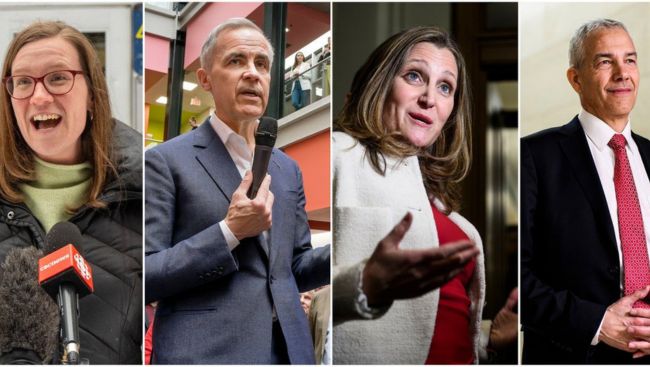
He wasn't on the stage but U.S. President Donald Trump's shadow towered over the Liberal leadership race during Monday night's French-language debate.
The candidates — former central banker Mark Carney, former finance minister Chrystia Freeland, former government House leader Karina Gould and former MP Frank Baylis — spent much of the debate talking about the threat Trump poses to Canada's economy and sovereignty.
Carney said that Trump has changed since his first term and is now more "isolationist, more aggressive."
"Trump of today, he isn’t the same as before," he said. "Before, he wanted a piece of our economy. Now, he wants our country."
Carney said that the first step when negotiating trade with the Americans is to be clear about what won't be on the table: supply management, culture and water.
"We need to focus on what we can control," he said. "We can’t control President Trump. We need to reinforce our economy immediately. It will reinforce our negotiating position."
Gould agreed and said Canada needs to stand up for its economy.
"We need to understand that Canadian businesses have a lot to offer the world," she said. "Not just the United States but other countries."
Freeland said Trump poses a once-in-a-generation threat to Canadian sovereignty.
“Trump represents the biggest threat to Canada since World War II. He threatens us with economic war," Freeland said in her opening remarks.
"Last time he was president, he threatened us. And I was successful in protecting Canada. This time, his threats are worse.”
Baylis said the talk of negotiation with Trump is meaningless, since Canada already has a trade agreement in place which isn't being respected by the American president.
He proposed forming a new economic alliance with the United Kingdom, Australia and New Zealand.
Based on polls and fundraising to date, Carney is the clear front-runner — making him the target of Conservative attack ads in recent weeks. Opinion surveys suggest his candidacy has helped the Liberals close the polling gap with the Conservatives, though questions about his proficiency in French lingered leading up to Monday's debate.
During an exchange about the war in Gaza, Carney stumbled by saying that the Liberal candidates were in agreement "with" Hamas. Carney later clarified, saying he meant to state that the candidates were all in agreement on their positions on Hamas.
The Conservatives quickly jumped on the slip-up and questioned Carney's ability to communicate clearly in French.
"You don’t control the question, only your answer. The higher up you go, the more this matters," Conservative MP Dan Albas posted on X, in response to Liberal MP Anthony Housefather coming to Carney's defence.
"If Mr. Carney doesn’t understand that, he should not be seeking the highest office in the country."
In the post-debate press conference, the first question Carney faced was on his command of the French language.
"I look forward to having a debate with (Bloc Québécois Leader) Yves-François Blanchet and (Conservative Leader) Pierre Poilievre in the French language," Carney said, switching to French halfway through his answer.
On the topic of health care, Baylis presented the most detailed plan of any candidate on the stage.
Prompted by a question on how to improve Quebec's health-care system, Baylis — who made his fortune in medical technology — spoke confidently about his vision to "build the best health-care system in the world."
"Right now we only have two doors to enter the health system. You either have a doctor or you have to go to the emergency room," he said.
"So I want to form more nurse practitioners, invest in homecare, and I want to enlarge the practice of pharmacists to give them more diagnosing power.”
Freeland was the first to answer the question and pitched her plan to recruit doctors and nurses from the U.S. to Canada.
Carney spoke about eliminating obstacles for doctors and nurses in Canada and utilizing artificial intelligence in health care, while Gould spoke of holding the provinces more accountable for how they spend their federal health transfers.
"In my view, there was too much money spent without results. It’s not for the federal government to have these results, it’s Canadians because it’s their money," Gould said, adding she wants agreements with provinces and territories on mental health services.
The candidates knew the broad themes they would be discussing going into the debate but not the specific questions they would be asked.
With little time remaining until voting begins, and just two weeks before the winner is announced, these debates are the only opportunities Liberal supporters will get to see the candidates together.
Advance voting opens Wednesday for party members.
The winner of the race, to be announced March 9, will replace Prime Minister Justin Trudeau as both Liberal leader and prime minister, though a general election call is widely expected soon after the votes are counted.


