
Saturday, July 4, 2026
ADVT 
National

Liberals formalize majority, move to limit debate on committee restructuring

Darpan News Desk The Canadian Press, 27 Apr, 2026 10:31 AM
  • Liberals formalize majority, move to limit debate on committee restructuring

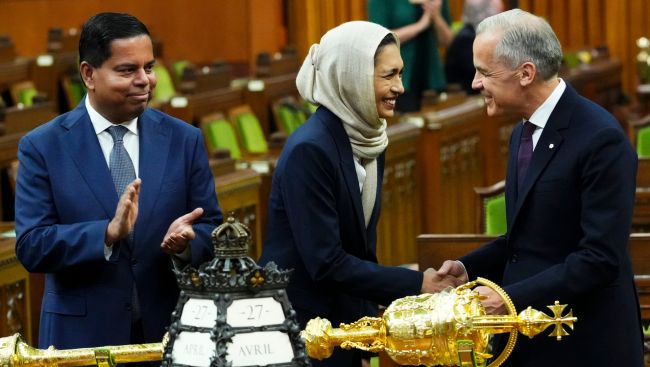
The three Liberals who won the byelections that secured a majority government for Prime Minister Mark Carney earlier this month took their seats in the House of Commons on Monday.

The government moved quickly to make use of its new majority powers by introducing a motion to limit debate on a change to the House rules that would enable the Liberals to take control of committees.

The Liberals are looking to change the structure of committees to ensure they have a majority of members. Committees study legislation and other government business and have the power to call witnesses and require the production of documents.

Government House leader Steven MacKinnon said the changes reflect the "long tradition" in Parliament that majority governments also hold a majority of seats on committees — though he acknowledged the situation is unusual.

"Let's agree that it does not happen often that governments change status such that they grow to have a majority of the seats in the elected chamber during the typical mandate," he said.

Opposition House leader Andrew Scheer decried the move as undemocratic.

"The very first vote that these new Liberal MPs will pronounce on will be a vote to shut down debate. So welcome to the Liberal Party of Canada, you can check your soul in at the door and just follow whatever the whip tells you to do," Scheer said.

The Liberals have enough voting members to force the changes through, in spite of the opposition.

There are now 174 members on the government benches after five MPs — four from the Conservative benches and one from the NDP — defected over the last six months.

Doly Begum, Danielle Martin and Tatiana Auguste took their seats on Monday after they were formally sworn in as members of Parliament on Saturday.

Begum and Martin are newcomers who replaced outgoing cabinet ministers Bill Blair and Chrystia Freeland in Toronto-area seats.

Auguste won the seat in the Bloc Québécois stronghold of Terrebonne in a rematch after the Supreme Court of Canada invalidated the results of last April's election in the riding. The court found that Elections Canada had made an error in the printed return addresses on some mail-in ballots and ordered the vote redone.

Auguste increased her one-vote margin in 2025 to more than 700 votes this year.

Most members of the Liberal caucus came to the Commons chamber to welcome their newest colleagues with standing ovations and a few hugs.

No more than two dozen MPs filled the sparsely populated opposition benches, and none of the other party leaders were there.

The new additions came on the same day NDP MP Alexandre Boulerice announced that he was leaving the party to sit as an Independent MP before he resigns to run provincially for the Québec Solidaire this fall.

The departure leaves the New Democrats with just five seats in Parliament. The party's new leader, Avi Lewis, is not an MP.

"I'm not fazed by this," Lewis said Monday, adding that Boulerice began considering the move to provincial politics well before he was chosen as the leader.

A byelection must be called within six months of Boulerice's resignation in his riding of Rosemont-La Petite-Patrie. 

Picture Courtesy: THE CANADIAN PRESS/Sean Kilpatrick

MORE National ARTICLES

B.C. Court of Appeal orders new trial for husband in 'rape role-play' case

B.C. Court of Appeal orders new trial for husband in 'rape role-play' case
The B.C. Court of Appeal says a man convicted of sexually assaulting his wife deserves a new trial because messages between the pair about a consensual "rape role-play" scenario were wrongfully excluded as evidence. The ruling released on Friday says the complainant and accused, who can't be identified under a publication ban, were married but separated at the time of the alleged sexual assault in November 2019. 

B.C. Court of Appeal orders new trial for husband in 'rape role-play' case

6 charged in illicit drug trafficking

6 charged in illicit drug trafficking
Police in Burnaby say six people are facing a combined total of 36 charges related to illicit drug trafficking. A statement from the R-C-M-P says they were part of a "particularly violent" drug-trafficking organization with links to the Lower Mainland gang conflict.

6 charged in illicit drug trafficking

Man charged in fatal Coquitlam stabbing

Man charged in fatal Coquitlam stabbing
Police say a 32-year-old man has been charged with second-degree murder after a fatal stabbing outside a Coquitlam pub last week. The Integrated Homicide Investigation Team says Coquitlam R-C-M-P had responded to a call about a fight outside the John B Pub on Friday night.

Man charged in fatal Coquitlam stabbing

Canada's chief justice decries misinformation as top court turns 150

Canada's chief justice decries misinformation as top court turns 150
Canada's top court is expanding its public outreach to build trust at a time of increasing misinformation as more people get their news from social media. Chief Justice Richard Wagner and other justices of the Supreme Court of Canada launched a cross-country tour in Victoria, B.C., on Monday to mark the court's 150th anniversary.

Canada's chief justice decries misinformation as top court turns 150

Weak loonie signals economy is 'in trouble': currency expert

Weak loonie signals economy is 'in trouble': currency expert
The Bank of Canada's end-of-day exchange rate Monday had the loonie trading at 68.48 cents US, but the Canadian dollar neared 70 cents in the minutes after Prime Minister Justin Trudeau said the planned tariffs would be paused for at least 30 days. The overall trend for the Canadian dollar however has been weak, which has implications for the economy. 

Weak loonie signals economy is 'in trouble': currency expert

Interprovincial trade barriers: what they are, why they exist and how to cut them

Interprovincial trade barriers: what they are, why they exist and how to cut them
The Trump administration's on-again, off-again threat to impose damaging tariffs has boosted an old idea for driving economic growth in Canada: eliminating interprovincial trade barriers. Here's a look at how interprovincial trade barriers work and why years of efforts to tear them down them have largely failed.

Interprovincial trade barriers: what they are, why they exist and how to cut them