The number of Canadians reporting having been directly affected by extreme weather events has increased since a year ago, a new poll suggests.
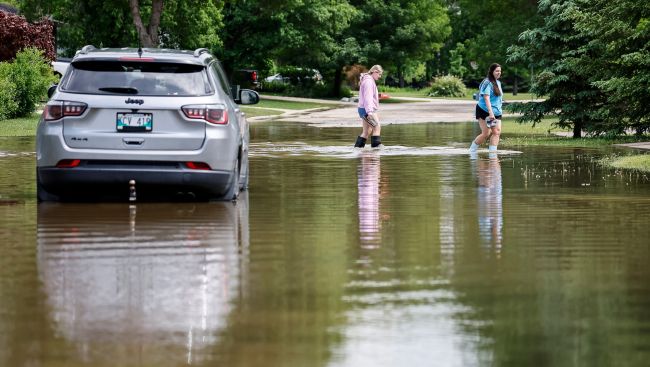
An online poll by Leger of 1,512 Canadians from June 12-15 indicates 30 per cent of respondents said they were personally affected by extreme weather events like heat waves, floods, fires and tornadoes over the last 12 months.
That's up from the 23 per cent who said the same in a June 2025 poll.
Because the poll was conducted online, it can't be assigned a margin of error.
The new figure is down from the 37 per cent of poll respondents who said in September 2025 they'd been affected by extreme weather. That September poll was conducted after Canada's second-worst wildfire season ever, when fires consumed nearly 90,000 square kilometres — an area larger than New Brunswick and P.E.I. combined.
But the ways in which Canadians are being affected by severe weather are not clear. Fifty-nine per cent of respondents to this latest poll said they had been forced to stay indoors because of poor air quality — down from 65 per cent a year ago — while 21 per cent said they had to cancel travel plans, down from 27 per cent.
The increase came in the number of respondents who answered "other" when asked to describe their experience with extreme weather — 13 per cent, up from eight per cent a year ago.
Andrew Enns, Leger's executive vice-president for Central Canada, said extreme cold over the past winter could be on the minds of some Canadians.
"Broadly across Eastern Canada and up to the Prairies, extreme cold seemed to rise a little bit," Enns told The Canadian Press.
"I wonder a little bit about the general nature of Canadians, you know, maybe complaining a bit about the weather."
The new poll also suggests more Canadians said there are more extreme heat events than there were five years ago, but the number of Canadians who are concerned about hot summers and heat waves has decreased significantly since last year.
Sixty-one per cent of respondents said there are more extreme heat events than five years ago, up from 55 per cent last year. But the number of Canadians who reported they're concerned about hot summers and heat waves in the future declined sharply from 62 per cent to 32 per cent.
"Yeah, it's crazy," Enns said of the 30 percentage point drop.
"It's that lived experience happening right now seems to really have an impact in terms of the level of concern on that."
Enns said media coverage of the El Niño weather system and speculation about a hot summer ahead may be playing into people's concern levels.
In a summary of the poll, Leger said the decline "may also be linked to cooler and less dry conditions observed in June 2026 compared to previous years."
Enns also suggested people can only maintain heightened awareness of extreme weather for so long.
"We see that a lot with some conflicts, where the first month or two of a conflict everybody's dialed in. But as it drags out, it just starts to sort of, doesn't go away, but the intensity really diminishes," Enns said.
The poll found 65 per cent of respondents said there are more wildfires now than five years ago, down from the 74 per cent recorded in last year's poll.
The number of Canadians who are worried about the changes in Canada's climate ticked up slightly to 61 per cent from 59 per cent a year ago.
The Canadian Research Insights Council, an industry organization that promotes polling standards, says online surveys cannot be assigned a margin of error because they do not randomly sample the population.
Picture Courtesy: THE CANADIAN PRESS/John