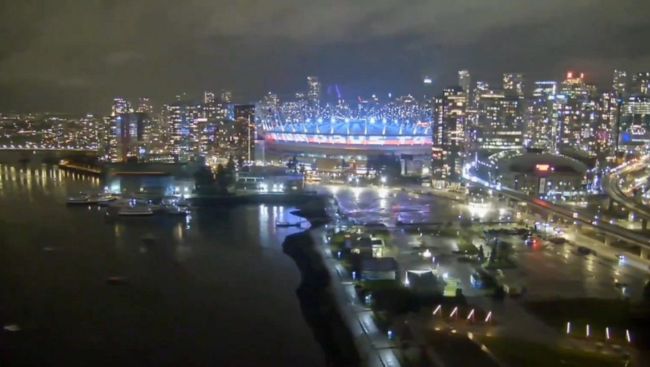
A meteor that NASA says soared across the night sky above Metro Vancouver at about 100 times the speed of sound set off a fireball, a sonic boom and an explosive response online.
Social media was filled with videos and reactions on Tuesday night after the bright flash and house-rattling boom was seen and heard over southwestern B.C. at roughly 9:10 p.m., with footage showing the sky brightening from one horizon to the other.
Michael Unger, director of programming at the H.R. MacMillan Space Centre in Vancouver, said his email "started to blow up as people started making reports" about the event.
"These events happen all the time," Unger said. "What is rare about this event is that it created a sonic boom over a populated area.
"Our planet moving through space is encountering these rocky objects all the time. It's just that the majority of them are of the smaller variety, and they'll just leave a streak across the sky, like a shooting star, like we see during meteor showers."
He estimated that the meteor could have been anywhere from 10 to 100 centimetres in size.
Robert Lunsford with the American Meteor Society agreed, saying a review of the reports coming out of B.C.'s Lower Mainland suggest the bright flash was likely a "fireball," a type of meteor that is larger and brighter than normal.
Lunsford, based in San Diego, also said the flash was unlikely to have been caused by human-made space debris given its short duration.
"Average meteors are only the size of a pea," he said in an email response. "It is their high velocity that makes such a small object visible in the night sky.
"A meteor the size of a softball can produce a flash as bright as the full moon and qualify as a fireball. Therefore, this object was still relatively small, but capable of producing an impressive sight in the sky."
In a statement, NASA confirmed reports of a meteor over the Pacific Northwest shortly after 9 p.m. Tuesday.
Based on "fireball reports" received by the American Meteor Society and data from a National Oceanic and Atmospheric Administration satellite, the agency said the meteor became visible about 98 kilometres above Coquitlam, B.C.
NASA said it was travelling slightly east of north at a speed of about 33 kilometres per second, or about 119,000 km/h.
The meteor traversed about 71 kilometres through the upper atmosphere before disintegrating at an altitude of about 65 kilometres above Greenmantle Mountain in B.C.
Witness reports described a flash seen over a long range, while the sonic boom that followed could be heard from the Fraser Valley to Washington state.
Alison Bird, a seismologist from Natural Resources Canada's earthquake early warning operation, said a few local seismometers in B.C. — all in the Lower Mainland — clearly picked up the shaking at 9:10 p.m.
She added the agency could confirm the shock was "not an earthquake" but could not give a specific location, as its system is designed to detect movements within the Earth and not the atmosphere.
Unger said Tuesday's meteor may have left small fragments that reached land, but finding them will likely be "needle in a haystack" due to their nickel-iron composition.
He added that while the meteor sighting is helpful in generating public interest in astronomy and understanding the universe, it is also a reminder of the possible threats of such objects and their potential damage if left unmonitored.
Unger said that the last large observed meteor event in Chelyabinsk, Russia, in 2013 created a sonic boom that shattered windows and caused a number of injuries, and the potential for a catastrophic strike remains, even if the odds are minuscule.
"We have not had an event like that in a very long time, but just like we're preparing for earthquakes, preparing for that big one to happen, we need to prepare for when we potentially could have a rock like that is going to connect with the Earth," Unger said.
He said different space agencies around the world are working on early warning systems.
"It's a reminder that if these objects get bigger, and we know that there's bigger ones out there, that if they do hit the Earth, then we could be starting to think about some larger catastrophes."
Picture Courtesy: THE CANADIAN PRESS/Handout — YouTube, Vancouver Views Live