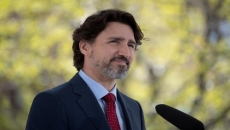
Tighter border controls will come into effect Feb. 22, the prime minister said Friday, not to punish travellers but to try to keep everyone safe.
I’ve got a few updates on our vaccine rollout, border measures, and response to COVID-19. Tune in now for the latest: https://t.co/jYdmGX16qF
— Justin Trudeau (@JustinTrudeau) February 12, 2021
Forcing new arrivals into a mandatory three-day hotel quarantine — at their own expense — and requiring a COVID-19 test when they get here is meant to help ward off new and more transmissible variants of COVID-19, Prime Minister Justin Trudeau said.
Nobody wants a third wave to start, Trudeau said at a news conference outside his Rideau Cottage home.
"Our goal is not to punish people," he said in French.
"Our goal is to protect and to discourage any non-essential travel."
The government had announced the plan for the new border controls last month but how they will work, who might be exempted and how they will be enforced was laid out Friday.
All those coming into Canada for non-essential reasons were already required to quarantine for 14 days and since early January, air travellers have had to show proof of a negative COVID-19 test before boarding their Canada-bound flights.
That requirement is also set to be applied at the land border as of Monday. Beginning Feb. 22, those arriving via the land border must also take another COVID-19 test at the end of their quarantine.
The forced quarantine in a government-approved hotel for air travellers could be followed by a stay in a government-approved isolation facility should they test positive for COVID-19.
Those who test negative can continue on to their previously arranged quarantine location.
The cost of the hotel stay, including the COVID-19 test, transportation and meals, could be as much as $2,000, the government had previously said.
Travellers will be able to book their government-authorized stay starting Feb. 18.
Right now, all travellers, with some exceptions for essential workers, must isolate for 14 days upon arrival, no matter if they came into the country via land or air.
But here is what's known for now:
Air travel
— All incoming travellers must provide proof of negative COVID-19 PCR tests (the kind typically taken with a deep nasal swab) done within 72 hours of boarding their aircraft.
— As of Feb. 22, upon arrival, each traveller will be required to take another test at the airport.
— From there, they must go to government-approved hotels for up to 72 hours, at their own cost, to await the results. Hotels are to begin accepting reservations Feb. 18.
— If that test is negative, a traveller can leave the hotel and continue on to finish quarantine at home or another approved location. They will have to take another test at the end of their time in quarantine and will be given that test to take with them.
— If the arrival test comes back positive, the traveller will be transferred to government isolation facility.
Land border
— As of Feb. 15, each traveller arriving at the land border, with exceptions for essential travellers, will be required to provide proof of a negative COVID-19 PCR test taken in the U.S. within 72 hours, or proof of a positive test result between 14 and 90 days before arrival — long enough ago for the illness to have passed, but not so long that immunity might have waned.
— As of Feb. 22, travellers will also be required to take COVID-19 tests upon arrival. Certain border points will be able to test on-site; if that's not an option, travellers will be given a kit to take home. They'll have to do a followup test 10 days later.