.jpg)
Prime Minister Justin Trudeau urged Donald Trump to think twice Monday before imposing new tariffs on Canadian aluminum, saying the sector is emerging from the pandemic-induced production stance that prompted the White House to consider such measures in the first place.
Trudeau, who said in a news conference he had spoken to the U.S. president earlier in the day, told him that with the North American economy getting back up to speed, Canada's aluminum smelters would soon be back producing value-added specialty products for the American auto sector.
The spectre of new tariffs emerged last month after Canadian producers, unable to shut down production and with their usual customers hamstrung by the impact of COVID-19, were forced to make a more generic form of aluminum and ship it to warehouses in the United States.
That alarmed certain U.S. smelter owners and operators, who have been urging the U.S. trade representative's office to slap fresh levies on imports from Canada.
The pandemic "caused certain disruption in the aluminum sector that is starting to realign itself, given the economies are starting up again and manufacturing is getting going," Trudeau said after his call with Trump.
"I impressed upon him that it would be a shame to see tariffs come in between our two countries at a time where we're celebrating NAFTA and at a time where we want our businesses and our manufacturers to get going as quickly as possible."
Canada has been on the outside looking in when it comes to the coming into force of NAFTA's successor, the U.S.-Mexico-Canada Agreement, which took shape in 2017 and 2018 before a backdrop of steadily worsening relations between Trump and Trudeau.
While Trump welcomed Mexico's President Andres Manuel Lopez Obrador to a celebratory event at the White House last week, Trudeau kept his distance, citing the tariff dispute and the ongoing COVID-19 pandemic among his reasons. A readout from Monday's call said the prime minister "expressed regret" for being unable to attend.
The U.S. trade representative reportedly gave Canada a deadline of July 1 to impose export restrictions — the very day the USMCA took effect. That deadline has come and gone without a hint from either the White House or U.S. trade ambassador Robert Lighthizer about what happens next.
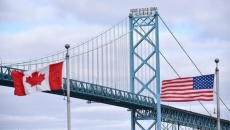
Trudeau said he and Trump also discussed the Canada-U.S. border, where non-essential travel has been curtailed since March in an effort to limit the spread of the novel coronavirus. The 30-day bilateral agreement to limit discretionary cross-border travel without restricting trade or essential workers has been extended three times and is now set to expire July 21.
Since the last extension, however, the public health crisis in the U.S. has exploded.
More than 100,000 new COVID-19 cases were identified over the weekend, particularly in southern states that reopened early, with Florida emerging as the new epicentre. Canada has had 108,000 confirmed cases in total, compared with more than 3.3 million cases and 135,000 deaths in the U.S. to date.
Hospitals in major urban centres across the United States are again nearing capacity and health care workers face another critical shortage of personal protective equipment like masks and respirators.
Recent polls suggest Canadians remain unequivocally opposed to reopening the border any time soon — a predictable symptom of the accelerating crisis in the U.S., said Kathryn Friedman, a University at Buffalo law professor and Wilson Center global fellow.
But there could be other lingering foreign-policy irritants at play, she added.
"I wonder if the United States had treated our dear neighbour, friend and ally a little bit better over the last three-and-a-half or so years, if the reaction would be as harsh," Friedman said. "Maybe people are just like, 'Well, too bad, I don't care if you want to open the border.'"
Friedman is among several Canada-U.S. experts, border community leaders, northern state lawmakers and others who want to see a plan for when the time comes to lift the restrictions.
"I think we have to have this conversation," she said. "I think we have to engage the right people now, so that when the border restrictions are eased, whenever that's going to be, they are done so responsibly."
It's less a question of when and more a question of how, Friedman said — what sort of controls, testing and screening measures and other tools will need to be in place even after the emergency has passed.
"I'm more concerned that the climate will change, and some relevant government officials won't have given any thought to how this border opening is going to take place," she said.
"We have to get our act together and really think more clearly about how we're going to handle these kinds of situations in the future, and really use science-based data — an evidence-based, science-based approach — to health screenings when it comes to border restrictions and border policies."
Trudeau demurred Monday when asked whether this time, Canada and the U.S. might negotiate a closure that lasts longer than the standard 30-day window.
"We will be discussing with our American partners what the next steps should be, and I think this is a situation that is evolving rapidly and we need to keep responding to the situation on the ground."