EDMONTON - The federal government says it will come to Alberta’s aid as the province’s hospitals face an overwhelming wave of COVID-19 patients.
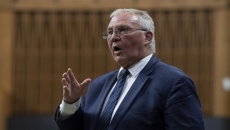
Bill Blair, the federal minister of public safety and emergency preparedness, says Ottawa will help with Alberta’s request for more critical care medical staff and Armed Forces' help airlifting patients to other provinces.
“The Government of Canada will support the provincial government’s recent request and provide the necessary support,” Blair wrote in a statement posted on social media Thursday.
“The federal assistance includes a range of capabilities, including the deployment of (Canadian Armed Forces) medical resources and/or aeromedical evacuation capability, as well as the deployment of Canadian Red Cross resources.”
Alberta has asked for help from the federal government and from other provinces as it deals with a rise in COVID-19 cases that threatens the viability of the health system.
Alberta Health Services said there are 310 patients in intensive care, the vast majority of whom have COVID-19. Of those with COVID-19 in critical care, most are not fully vaccinated or not vaccinated at all.
This is the highest number of people in critical care in Alberta at any one time since the pandemic began in early 2020.
The United Conservative Party government has scrambled to create extra critical care beds, effectively doubling the original baseline total of 173, and has redeployed staff to manage them.
The result is the mass cancellation of non-urgent surgeries across Alberta. Doctors are being briefed on how to decide who gets life-saving help and who doesn’t should remaining resources become depleted.
There are more than 20,000 active COVID-19 cases and more than 1,000 people in hospital with the illness. Deaths are on the rise. There were 29 fatalities reported Tuesday and 20 more on Wednesday, including the first person under age 20.
In Calgary, Alberta's Opposition NDP leader said it’s time Premier Jason Kenney hand over public health decisions related to the COVID-19 crisis to medical professionals.
Rachel Notley said it has become clear that Kenney is more focused on his political survival than on the pandemic.
“It never should have come to this,” Notley said.
“Jason Kenney knew his plan wasn’t working as early as July and he did nothing. In fact, he left (on a vacation). All through August and into September the UCP refused to act while the crisis escalated.
“Now all Albertans are suffering the consequences of the UCP’s collective inaction and ineptitude.”
Notley said sound public health decisions are being undermined by political compromises. She called for those decisions to be turned over to Dr. Deena Hinshaw, Alberta's chief medical health officer, backed by an independent scientific panel of advisers.
“(Albertans) are demanding better leadership from their government to get through this pandemic. But instead of taking action to protect Albertans, Jason Kenney and the UCP seem to be laser-focused on protecting themselves,” said Notley.
Kenney has been facing escalating criticism and calls for his resignation over his handling of COVID-19. The criticism began before last Christmas when his government was late to react to a second wave swamping hospitals. The government was late again in the third wave in May and is now chasing the pandemic in what has become the fourth, and worst, wave to date.
At each stage, he has been accused of pandering to anti-restriction elements in his party and caucus at the expense of public health.
Some United Conservative constituency associations are pushing for an immediate review of his leadership.
Joel Mullan, the party’s vice-president in charge of policy, has openly called for Kenney’s resignation, saying the public and the party have lost trust.
Kenney met with his caucus Wednesday and later asked the party to move up a leadership review from late 2022.
“The premier spoke with the president of the party on Wednesday and requested that the 2022 UCP (annual general meeting) take place in the spring and that the scheduled leadership review occur at that time,” Dave Prisco, the UCP director of communications, said in a statement.
“The party is working to confirm a date and venue to make it a reality.”
Kenney deflected reporter questions earlier this week on whether he should resign, saying he is focused on the COVID-19 crisis and not on political intrigue.