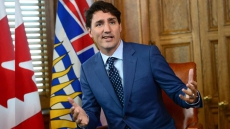
Prime Minister Justin Trudeau said Monday that his government is launching a $1.75-billion fund to expand high-speed internet to Canadians in rural and remote communities.
Over the past five years, our government has invested $6 billion in broadband and connected 1.2 million households to high-speed internet. What we’ve announced today builds on that work and is the largest one-time federal investment in broadband in our country’s history.
— Justin Trudeau (@JustinTrudeau) November 9, 2020
The Universal Broadband Fund that was part of the Liberal budget announcement in early 2019, months before last year's federal election, has taken longer than expected to be officially launched.
But the PM and several of his ministers said they used the time to make the funding process less cumbersome and more relevant to communities, recognizing that the COVID crisis has made good internet an even higher priority than before the pandemic.
Fast and reliable internet isn’t a luxury. It’s a basic service that everyone deserves to have access to - no matter where you live. That’s why we’re launching our Universal Broadband Fund today, and aiming to connect all Canadians to high-speed internet by 2030.
— Justin Trudeau (@JustinTrudeau) November 9, 2020
"The program we are launching today … reflects the advice and recommendations on how best to solve the most important infrastructure challenge of our time, how to strengthen our connections," said Maryam Monsef, minister for rural economic development. "We were ready to go, in March, with the new Universal Broadband Fund. And then the pandemic hit."
Today is a big day for 🇨🇦. This morning, we announced the launch of the Universal Broadband Fund - a $1.75 billion investment that will help connect every Canadian household to high-speed internet - no matter where they live. For more: https://t.co/24ZUfFxVX7 pic.twitter.com/fd0RdHYmFZ
— Maryam Monsef (@MaryamMonsef) November 9, 2020
In response, the government consulted with members of Parliament from rural areas and officials with local governments that were overloaded by the demands of the COVID crisis.
"We heard that the processes have to be streamlined and more easily accessible," Monsef said. "We also heard that communities are, rightfully so, impatient to see progress."
As a response, she said, the government is ready to accept applications immediately, there's a new service to assist with navigating the system, and $150 million of the $1.7 billion is designated for projects that are ready to be completed by next November.
Trudeau said the Universal Broadband Fund will see 98 per cent of Canadians connected to high-speed internet by 2026 — crucial in an era when virtual communication is an essential part of daily life.
“Good reliable internet isn’t a luxury, it’s a basic service," Trudeau said Monday at a news conference in Ottawa.
"We’re all going online to stay in touch with family and friends. Now more than ever a video chat cutting out during a meeting or a connection that’s too slow to upload a school assignment, that’s not just a hassle, that’s a barrier."
The program, announced originally in the Liberal government's 2019 budget as a $1-billion fund, includes $750 million of added cash to advance projects with partners such as the federal infrastructure financing agency.
In addition to the Universal Broadband Fund, the government announced a $600-million deal with Ottawa-based satellite company Telesat to link up particularly remote communities with high-speed broadband via satellite.
Innovation, Science and Industry Minister Navdeep Bains said Telesat's low-orbit satellites are scheduled to be deployed in late 2021 and service is projected to begin in 2022.
Access to the internet is a vital part of how Canadians work, learn, and socialize. No one should be excluded from the opportunities provided by getting online. That’s why today we’re announcing a major investment in Canada’s Universal Broadband Fund. https://t.co/taRoj8nNNu pic.twitter.com/PpyPj87mZr
— Navdeep Bains (@NavdeepSBains) November 9, 2020
Bains also acknowledged that many communities in the North have faced bracingly high internet fees. He said the government believes competition among different service providers would "enable the price points to go down."
The Universal Broadband Fund is only one of many federal programs, often with similar or complementary mandates.
For example, it's partly an evolution of the Connect to Innovate program that the Trudeau government announced in its first mandate, to connect more households to the internet, and partly a complement to its $35-billion infrastructure bank.
The Liberals created the Canada Infrastructure Bank in 2017 to entice funding from private-sector partners to fuel what the government has called "transformational" infrastructure projects that would create 60,000 jobs.
However, the bank has been criticized for its relatively small number of investments in fewer than a dozen projects so far and both the Conservatives and NDP promised in the 2019 election to abolish the bank if they were voted into power.