Saturday, June 20, 2026
ADVT 
National

Poll finds widespread support for new travel rules

Darpan News Desk The Canadian Press, 02 Feb, 2021 06:34 PM
  • Poll finds widespread support for new travel rules

The vast majority of Canadians support tighter restrictions on international travel imposed by the federal government, a new poll suggests.

Eighty-six per cent of respondents agree with stricter measures that suspend flights to most sun destinations and require quarantining at a hotel at the passenger's expense upon arrival in Canada, according to an online survey by Léger and the Association for Canadian Studies.

The poll also found that 87 per cent of respondents think the government should go further by banning international travel until there are several consecutive days of reduced COVID-19 numbers.

The wariness of foreign trips stems in part from more transmissible — and possibly more lethal — variants of the virus emerging abroad as well as homegrown politicians jetting off to far-flung beaches during the holidays, says Léger executive vice-president Christian Bourque.

“We probably would not have gotten such high numbers before the whole talk about the South African variant, the Brazil variant," Bourque said in an interview. "I think this probably jolted Canadians in a way.

"And then when you see people coming back with a very nice tan, you’re thinking, 'Why am I making the effort and you're not?' And in certain cases it was MLAs and even (provincial) cabinet ministers," senators and MPs, he noted.

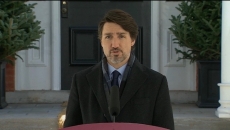
Prime Minister Justin Trudeau announced last Friday that Canadian airlines have suspended flights to Mexico and the Caribbean until April 30 and that returning passengers will soon have to self-isolate at a federal facility for up to three days after taking a PCR test at the airport.

The reaction differed depending on geography, with 91 per cent of respondents from Quebec and Atlantic Canada in favour of the new restrictions but just three out of four Albertans backing the clampdown, the poll found.

The possibility of even stricter rules such as an outright ban on international travel raises questions around the flow of essential goods, many of which enter the country in the bellies of passenger planes, and around freedom of movement as guaranteed in the Canadian Constitution.

Section 6 of the Charter of Rights and Freedoms states that "every citizen of Canada has the right to enter, remain in and leave Canada," though all rights are subject to reasonable limits.

The urge for tougher travel rules comes as Canadians find their mental health on the wane, with just 29 per cent of survey respondents rating it as very good or excellent, the lowest since the pandemic began.

"We’re getting into the doldrums of February, and things are not improving. If you look from November to today, it’s a steady decline in self-perception of the state of your mental health," Bourque said.

Conducted Jan. 29 to 31, the online poll surveyed 1,559 Canadians. It cannot be assigned a margin of error because internet-based polls are not considered random samples.

MORE National ARTICLES

Police-escorted motorcade to accompany remains of helicopter crash victim

Police-escorted motorcade to accompany remains of helicopter crash victim
The remains of Sub-Lt. Abbigail Cowbrough, a Royal Canadian Navy sailor killed last month in a helicopter crash off the coast of Greece, were expected to arrive in Halifax on Monday. 

Police-escorted motorcade to accompany remains of helicopter crash victim

Virtual parliamentary proceedings cause spike in injuries for interpreters

Virtual parliamentary proceedings cause spike in injuries for interpreters
Virtual sittings of the House of Commons and parliamentary committees are causing headaches for interpreters — literally. Coping with iffy audio quality, occasional feedback loops, new technology and MPs who speak too quickly has resulted in a steep increase in interpreters reporting workplace injuries, according to the union that represents some 70 accredited interpreters who translate English into French and vice versa.

Virtual parliamentary proceedings cause spike in injuries for interpreters

Peter MacKay calls for China sanctions over COVID-19

Peter MacKay calls for China sanctions over COVID-19
Conservative leadership hopeful Peter MacKay is calling for use of the Magnitsky Act if specific individuals in China can be identified as having suppressed information related to COVID-19 A full inquiry, perhaps an international one, into how the novel coronavirus turned into a pandemic is required, MacKay told supporters.    

Peter MacKay calls for China sanctions over COVID-19

Despite jarring jobs numbers, Canada, U.S. charting different courses

Despite jarring jobs numbers, Canada, U.S. charting different courses
Prime Minister Justin Trudeau says it's a fundamental principle of life in Canada that no one should have to go to work if they don't feel safe doing so. Trudeau made the comments today as the country confronted some of the worst unemployment numbers in history — nearly two million jobs lost last month and an unemployment rate of 13 per cent.    

Despite jarring jobs numbers, Canada, U.S. charting different courses

B.C. government, Translink make agreement to keep transit rolling amid COVID

B.C. government, Translink make agreement to keep transit rolling amid COVID
Metro Vancouver's transportation authority has reversed its plans to cut service and rescinded layoff notices to 1,500 people as it works out an emergency funding plan with the provincial government. Translink and the province say in a joint news release that they are working on a comprehensive solution to address the financial impact on the service because of the COVID-19 pandemic.

B.C. government, Translink make agreement to keep transit rolling amid COVID

Trudeau says wage-subsidy program to be extended as steep job losses continue

Trudeau says wage-subsidy program to be extended as steep job losses continue
Prime Minister Justin Trudeau says the federal government's emergency wage-subsidy program will be extended beyond its early-June endpoint. The program covers 75 per cent of worker pay up to $847 a week to try to help employers keep employees on the job in the face of steep declines in revenue due to the COVID-19 pandemic.

Trudeau says wage-subsidy program to be extended as steep job losses continue