Monday, June 8, 2026
ADVT 
National

Premiers call for improved relationship with China during trade war with the U.S.

Darpan News Desk The Canadian Press, 23 Jul, 2025 10:49 AM
  • Premiers call for improved relationship with China during trade war with the U.S.

Canada's premiers have called on the federal government to improve the country's relationship with China in the face of the ongoing trade war with the U.S.

With tariffs and constant economic threats from U.S. President Donald Trump, Saskatchewan Premier Scott Moe and Ontario Premier Doug Ford say the country will need to deal more with China.

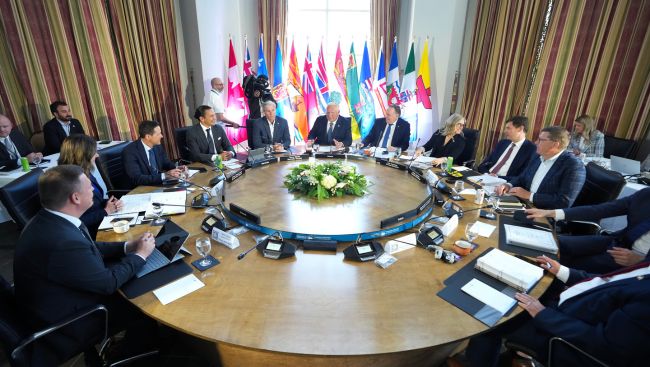
The premiers have gathered in Huntsville, Ont., for the third and final day of the Council of the Federation meeting.

"If we're truly going to move and expand our reliance away from the United States in any way, shape, or form — and I would suggest the only way to do it is on additional products produced, not existing — we're going to have to deal with China, and so we're going to need a broader relationship with them," Moe said.

Both Moe and Ford are worried about steelworkers in their respective provinces, with three major steel plants feeling the brunt of U.S. tariffs on steel, combined with China dumping steel into the market through proxy countries. 

"You know what Churchill said, our enemy of our enemy is our friend, and I don't consider Americans the enemy, but right now President Trump himself is acting like the enemy," Ford said.

He said Ontario imports about $40 billion worth of Chinese goods and exports about $3 billion.

"As long as China plays fair and doesn't undercut our markets, be it the auto sector or any sector," he said. 

"I have no problem dealing with them because we're already dealing with them."

Ford said he still supports the 100 per cent tariffs Canada imposed on Chinese-made electric vehicles last October, matching what the Biden administration had already done in the U.S., as well as 25 per cent tariffs on Chinese steel and aluminum.

Later in the fall, Canada imposed tariffs on a range of other Chinese goods, including EV batteries and parts, critical minerals, solar panels and semiconductors.

In response, China imposed 100 per cent tariffs on imports of Canadian canola oil and meal. It also has a 25 per cent levy on some pork, fish and seafood products from Canada.

Last week, Prime Minister Mark Carney announced a second round of protectionist and anti-dumping measures in response to the U.S. tariffs on steel and aluminum, targeting Chinese-made steel. Canada will raise the tariffs on Chinese steel and aluminum imports to 50 per cent and is adding a 25 per cent tariff on steel melted and poured in China, no matter where it comes from.

The premiers said in a statement they'd like the federal government to prioritize work toward the removal of Chinese tariffs on Canadian canola, peas, pork and seafood. 

They are also asking the federal government for changes to the bail system and more money for health care.

The premiers met with Carney on Tuesday to discuss the trade war with the U.S. after meeting with First Nation leaders the previous day.

The prime minister and the premiers presented a united front in the face of U.S. tariffs, but revealed little about the negotiations with an Aug. 1 deadline fast approaching.

The prime minister and the premiers all downplayed the importance of getting a deal done soon to avoid further U.S. tariffs, saying they want the best deal possible regardless of timing.

A number of provinces also signed several free-trade deals to open up internal trade, while others committed to building pipelines to get oil and gas to new markets.

The premiers are holding a closing press conference this afternoon. 

Picture Courtesy: THE CANADIAN PRESS/Nathan Denette
MORE National ARTICLES

B.C. doesn't know where all its groundwater is going. Experts worry as drought looms

B.C. doesn't know where all its groundwater is going. Experts worry as drought looms
Growing up on a ranch in the Columbia River Valley, water has always been part of Kat Hartwig's life, and over the years, she's noticed changes. Marshy areas her family used for irrigation or watering cattle are dry, wetlands are becoming "crunchy" rather than spongy underfoot, and snowmelt is disappearing more quickly each spring, ushering in the dry summer months, Hartwig says.

B.C. doesn't know where all its groundwater is going. Experts worry as drought looms

Health minister compares dentists' 'fears' on dental-care program to medicare rollout

Health minister compares dentists' 'fears' on dental-care program to medicare rollout
Health Minister Mark Holland says "concerns and fears" dentists are expressing about a national dental-care plan are similar to those doctors had when Canada launched medicare in the 1960s. He is defending his government's back-and-forth negotiations with dentists after dental associations said some of their members are hesitant to participate.

Health minister compares dentists' 'fears' on dental-care program to medicare rollout

Canada's spy agency saw low-level Chinese meddling activities in 2019 election: Gould

Canada's spy agency saw low-level Chinese meddling activities in 2019 election: Gould
The former minister of democratic institutions says she was told after the October 2019 federal election that Canada's spy agency had seen low-level foreign interference activities by China. Karina Gould, who held the portfolio from early 2017 to November 2019, said in a classified interview last month that the Canadian Security Intelligence Service indicated the activities were similar to what had been seen in the past.

Canada's spy agency saw low-level Chinese meddling activities in 2019 election: Gould

BoC holds key rate at 5%

BoC holds key rate at 5%
Governor Tiff Macklem says economic data since January has improved the central bank’s confidence that inflation will continue to slow, even as economic growth picks up. The governor says while the Bank of Canada is seeing the evidence it needs to begin lowering interest rates, it needs to see price pressures ease for longer to make sure the decline in inflation is sustained.  

BoC holds key rate at 5%

B.C. announces one-time $430 rent relief benefit to low-income seniors

B.C. announces one-time $430 rent relief benefit to low-income seniors
The British Columbia government is granting a one-time $430 benefit to the roughly 20,000 seniors in its support program for elderly low-income renters. B.C. Housing Minister Ravi Kahlon says eligible seniors don't need to apply for the payment, which will be sent out this month.

B.C. announces one-time $430 rent relief benefit to low-income seniors

Two blows to B.C.'s credit status, as S&P cuts rating and Moody's turns negative

Two blows to B.C.'s credit status, as S&P cuts rating and Moody's turns negative
British Columbia's credit status took a double blow on Tuesday, with S&P downgrading the province due to the risk of "outsize" deficits, and Moody's turning its outlook negative. S&P Global Ratings blamed big government spending as it dropped its credit rating for the province and BC Hydro's provincially guaranteed unsecured debt from AA status to AA-minus.

Two blows to B.C.'s credit status, as S&P cuts rating and Moody's turns negative