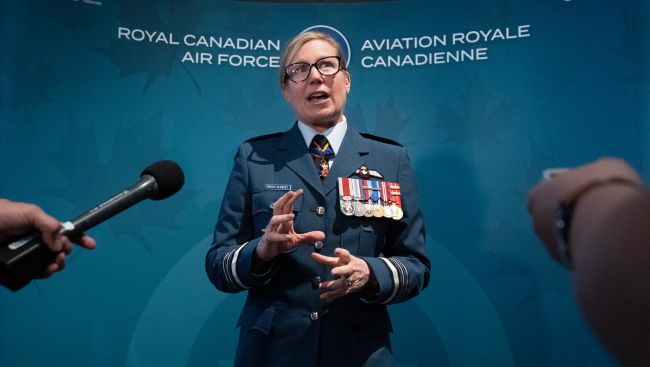
A substantial entry level pay hike for pilots and the acquisition of new and advanced aircraft are “absolutely” helping to shore up Royal Canadian Air Force pilot retention and morale, says the force's commander.
In a wide-ranging recent interview with The Canadian Press, Commander Lt.-Gen. Jamie Speiser-Blanchet said she is seeing signs of progress despite the protracted personnel crisis gripping the air force, which remains short of roughly 2,000 trained personnel.
“When you talk about a pay raise like that, it absolutely had a positive effect on the retention of our personnel, including pilots,” Speiser-Blanchet said. She noted her evidence is anecdotal and comes from touring bases and speaking with the rank-and-file.
Prime Minister Mark Carney announced a military pay raise last summer that — while military pay is complex and stratified by rank — amounts to a 20 per cent hike for entry level recruits. The force is also replacing large portions of its aircraft fleets as part of a major modernization effort.
“In the areas like the fighter force or the maritime patrol force and the others where they're getting new aircraft, people are very excited, and so that is causing an excitement that you can actually see,” Speiser-Blanchet said.
"They realize that, OK, things aren't going to necessarily be easy, and yes, things are changing, but they see investment, they see new equipment arriving."
The RCAF is bringing in P-8 Poseidons to replace the Aurora maritime patrol aircraft; the first delivery is expected this year. The CC-330 Husky is replacing the CC-150 Polaris. And the force is busy laying the groundwork for replacing the CF-18 Hornets it has relied on for decades with F-35 stealth fighters.
“The Huskies — some of them are here and they are seeing that we're not just talking about doing things," Speiser-Blanchet said. "Things are actually happening. And I believe that is creating a positive sense of excitement. I know I certainly feel it.”
The RCAF has struggled for years with staff shortfalls. As with other parts of the Canadian Armed Forces, some of the RCAF's key trades have been staffed at levels below what the military would consider a "critical shortage."
RCAF’s recruitment intake exceeded its attrition by 440 people in the last fiscal year.
Speiser-Blanchet said the force is making "significant progress" on fighter pilot numbers, a long-standing area of concern.
“The most fragile is still the fighter fleet when it comes to pilots, but I am happy to say that we've stabilized that area because it was the area of greatest concern," she said. "And we're absolutely continuing to focus on that to make sure that we can sustain the growth trend that we are working towards."
The RCAF maintains it has enough fighter pilots to meet current demands and the transition to the F-35s. CF-18 squadrons are "staffed at 70 per cent of their establishment," says the RCAF public affairs office.
A 2018 report by the federal auditor general warned the force had "only 64 per cent of the trained CF-18 pilots it needed to meet the government’s new requirement” and said the problem could bleed into the F-35 program. A 2025 report by the auditor general stated that the fighter pilot shortage persisted.
The 2018 auditor general report prompted changes to the pilot pay regime to bring it closer to private sector pay, but an internal National Defence review released publicly late last year said the changes brought on unintended side-effects.
It warned changes to pilot pay structure had actually caused frustration within the ranks, invited a "cluster of grievances" and resulted in some captains declining promotions because they could make more than a major.
Internal figures from spring 2025, released to The Canadian Press through the access to information law, reveal the force was short roughly 60 majors and about 50 captains at the time.
Significant flight training delays also have pushed up attrition among early recruits in recent years, along with other factors like the adjustment to military life.
The pandemic brought its own problems. It caused lengthy delays in early training that sometimes left pilots underemployed for several years before they could advance in their careers.
That dynamic has now changed for the better, Speiser-Blanchet said.
“Because of (the pandemic), there were some that waited, you know, two or three years, which was a very long time. That kind of wait time is not happening anymore,” she said.
She added that training delays still exist but are now manifesting in later stages and are much easier to manage.
"Because it's in the more operational flying unit area, we have a bit more flexibility with those winged pilots of how we can employ them," she said.
"The impact is not just people sitting around doing nothing. We're actually trying to find other ways to gainfully employ them until they can be fully qualified on the specific aircraft type that they've been selected for."
Speiser-Blanchet said the air force has also focused on improving its fighter training through work with international partner organizations, such as the International Flight Training School in Italy.
"We are seeing some very good results with the training program that is, basically, after a pilot gets their wings, they'll go do that as a fighter lead-in training," she said. "And then they'll come back to Canada and at the moment go in the F-18, then obviously in the future that phase will be the F-35."
Picture Courtesy: THE CANADIAN PRESS/Jacques Boissinot