TORONTO — Scotiabank is defending its income verification practices in light of a report that says Canadian banks allow foreign borrowers to qualify for mortgages without having to prove the source of their income.
A Globe and Mail report Wednesday said that Scotiabank's (TSX:BNS) internal guidelines don't require its loan officers to verify foreign clients' income sources if the down payment on a property is at least 50 per cent.
Scotiabank spokeswoman Diane Flanagan said the bank regularly makes exceptions to accommodate clients who can't provide standard documentation, such as Canadian tax returns and pay stubs, to verify their income.
Certain types of borrowers — such as non-residents, self-employed people and new Canadians — simply don't have those documents, Flanagan said.
"We look at exceptions on a regular basis, because there aren't one-size-fits-all policies for everybody," Flanagan said.
The bank still verifies the source of the money being used to fund the purchase and that the borrower is able to service the mortgage, she said.
In many cases, the due diligence required for those who can't provide standard documentation is even more rigorous, she added.
"It is entirely inaccurate to suggest there is preferential treatment" for foreign borrowers, Flanagan said.
The Globe and Mail said the exceptions to the regular rules for domestic borrowers were outlined in internal documents it reviewed from Scotiabank and the Bank of Montreal.
It reported that at the Bank of Montreal (TSX:BMO), foreign clients need a 35 per cent down payment to qualify for mortgages of up to $2 million to avoid having to verify their income.

The bank told The Canadian Press that the types of mortgage applications for foreign clients or newcomers being referred to in the Globe story are for loans of up to $1 million, not $2 million.
It is unclear whether the bank gives preferential treatment to foreign investors when it comes to granting mortgages.
"We assess every customer circumstance individually and consider multiple factors which include income and employment, credit bureau score where available, loan-to-value, value of the property and ties to Canada," a BMO spokesman said in an email.
The federal banking regulator said banks must always attempt to confirm income sources for mortgages, regardless of where the borrower is based.
"Whether the borrower is foreign or domestic, OSFI expects that institutions will take reasonable steps to verify income, and where income verification is inadequate, compensating controls need to be in place," the Office of the Superintendent of Financial Institutions said in a statement.
Royal Bank (TSX:RY) said in an email that the lender requires non-residents to provide proof of their income, either from an employer or a business, as well as a list of assets.
TD Bank (TSX:TD) said it reviews all applicants on a case-by-case basis and has "robust" processes in place to ensure customers are able to service their debt.
CIBC (TSX:CM) did not respond to questions.
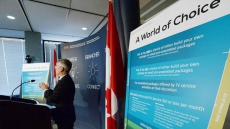
David Eby, B.C.'s NDP Opposition housing critic, said that if banks don't require foreign borrowers to verify their income, that would make it very easy for those borrowers to purchase multiple homes.
"It invites the kind of speculation that leads to empty homes," Eby said during a news conference Wednesday.
"It was a revelation to me to learn about this banking policy because it really explained a lot of things. It explained how people could potentially buy two or three homes, leaving two or three homes vacant ... because they weren't subject to the same pressures ... that a typical borrower would have to demonstrate."