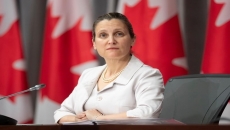
Finance Minister Chrystia Freeland is pledging to fill a gap in the government's bid to bolster hard-hit businesses with rent relief, but she faced stern questions from senators about transparency.
The House of Commons agreed last week to pass a proposed package of measures quickly, but none can be enacted until the Senate passes it as well.
The aid bill known as C-9, now under review by the Senate finance committee, would extend the federal wage subsidy until next summer — cancelling a previously planned decline in its value — and expand a popular business loan program.
The legislation would also redo a widely criticized program for commercial rent relief. The revamped program includes a requirement that entrepreneurs pay their rent before applying, putting the subsidy out of reach for many cash-strapped stores.
Facing backlash from industry, Freeland promised Thursday an interim solution "to make sure that rent payable is an eligible expense from day one."
While the aid bill now before the Senate will not cement that revision, the government will "swiftly" table legislation after C-9 is passed to formalize the pledge, she said.
In the meantime, Freeland has informed the Canada Revenue Agency of the government's plan.
"Given that this is our clear and publicly stated intention, we are confident that the CRA will consider rent payable as an eligible expense from the moment the new rent program is launched," Freeland told senators. "There will be no delay."
The hitch was revealed last week when Canadian Federation of Independent Business president Dan Kelly posted tweets warning that the legislation would make businesses cough up rent to be eligible for the cash.
The question of financial health and transparency related to the broader aid bundle came up repeatedly at Thursday's Senate committee hearing.
"Why is the government refusing to provide program and financial information to parliamentarians?" asked Conservative Sen. Elizabeth Marshall, calling for monthly updates on costing figures that are "very much lacking."
Conservative Sen. Larry Smith argued that Freeland and Prime Minister Justin Trudeau seem to have "two different opinions" of financial accountability, with the one calling for a "limited and temporary" fiscal response to the pandemic and the other brushing off the notion of fiscal anchors to ground government spending.
Freeland, replying that she and the prime minister are "like-minded," laid out finance department estimates.
The Canada Emergency Wage Subsidy, launched in the spring, will have provided an estimated $65.5 billion through December, she said.
The government will spend another $2.2 billion between now and the end of the year on the proposed Canada Emergency Rent Subsidy and top-up help for businesses whose revenues crash due to local lockdowns during the second wave of COVID-19.
More than one-third of small businesses are still seeing revenue declines of 50 per cent or more, the CFIB's Kelly told the Senate finance committee.
The spike in COVID-19 case counts has prompted a further sales drop at more than half of the country's 110,000 small- and medium-sized enterprises, he said.
"That’s deeply worrisome to us."
Pointing to "giant gaps" in the proposed programs before the Senate, Kelly called for new businesses to be better accommodated under the subsidy packages, most of which require businesses to have been operating before March 2020 to qualify.
"A franchise restaurant that opened, they put $470,000 of investments to get their restaurant up and running, they opened their doors in June, shut down again now and are completely ineligible to use the subsidy," he said.
The government should also double the wage subsidy amounts available to applicants of the revised wage subsidy, said Lauren van den Berg, vice-president at Restaurants Canada.
The industry group, whose 40,000 members have seen job losses of 188,000 this year, is demanding a subsidy of 1.6 times the decline in sales, up to a maximum of 75 per cent of wage costs.
Under Bill C-9, many entrepreneurs would receive a wage subsidy of just half that sum, or 80 per cent of sales.
"I know it sounds drastic to double it, but that’s because the assumptions made back in June have been cut in half," van den Berg said.
"When the government proposed the extension of the wage subsidy back in June and July, we were more optimistic as a country. The sun was shining, the weather was warm, patios could be enjoyed again," she told the committee.
"But the reality is that we’re now in the middle of a second wave. Now, winter is literally coming and indoor dining rooms are being shut down across the country."