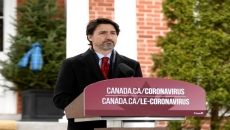
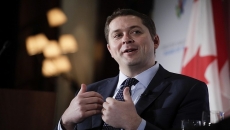
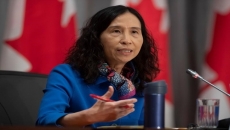
The federal New Democrats on Tuesday were once again grappling with a decision about whether to support the minority Liberal government or potentially force an election upon Canadians struggling with the latest wave of the COVID-19 pandemic.
But NDP Leader Jagmeet Singh refused to see it that way, saying that Prime Minister Justin Trudeau's decision to make a confidence matter out of the Conservatives' motion to create a special COVID-19 pandemic investigation committee was a "farce."
If the result is an election, that's on Trudeau to explain to Canadians, Singh said.
"I can't imagine how the prime minister of Canada would look those people in their eyes, people who are afraid and worried, and say, 'I know you're worried and afraid, but we're going to election because I don't like a committee,'" he said.
"That is outrageous and is absurd."
At issue is a Conservative motion that would create a special committee to probe allegations of misspending in COVID-19 programs, a move the Liberal say essentially means the opposition has no confidence in the government and an election should be held.
Justin Trudeau shut down Parliament to cover up the fact that he used the pandemic to funnel money to his friends.
— Erin O'Toole (@erinotoole) October 20, 2020
They don’t want to the truth to come out and this cover up is becoming quite desperate.
Conservatives will fight to get the answers we believe Canadians deserve. pic.twitter.com/AXNyQbOjxo
The Bloc Québécois have already said they support the Conservatives, meaning the pressure is on the NDP to decide which way to go: side with their opposition colleagues and bring down the government, or with the Liberals.
Singh was not clear on whether his party will back the motion but said negotiations are ongoing on a path forward.
What concerns him, he said, is whether the Liberals are even interested in negotiating.
"The prime minister is not looking for solution here, the prime minister is looking for an excuse to go to an election," he said.
"And I will not give the prime minister an excuse to go to an election … He is not going to be able to hide behind the opposition."
The Liberals have countered with their own version of a special committee, one a Liberal MP would chair and that would have a much broader mandate than the Tory proposal.
The Conservative version would focus on three COVID-19 relief programs having links to individuals or organizations with close ties to the Liberals.
Among them, the student grant program the Liberals intended to have managed by WE Charity, an organization with long-standing connections to the Trudeau family.
Several parliamentary committees had been probing that deal before the Liberals prorogued Parliament in August. Efforts to resume their work last month have been stymied by the Liberals' decision to filibuster committees where they have control.
The new committee proposed by the Conservatives would be chaired by an Opposition MP and have a majority of non-Liberal MPs, have the power to call everyone from the prime minister to civil servants as witnesses, demand the production of documents related to the various programs and take precedence over any other House of Commons committees to carry out that work.
The Liberals have argued that would paralyze government, a notion the opposition dismissed Tuesday.
Among the proposals from the NDP is to have the COVID-19 committee chaired by a member of the opposition to avoid the filibustering taking place at other committees right now.
"We can't trust a Liberal chair," NDP ethics critic Charlie Angus said during debate on the motion Tuesday.
"Let's vote on someone that all parties can agree would be a good solid opposition chair. That way we know we can get the job done. That's about working together. That's the offer that's on the table."
The Liberals gave no clear sign Tuesday that they were open to that, holding tight to their assertion that the more aggressive proposal from the Tories crosses a line.
The proposal is in the form of an Opposition day motion, a day in the parliamentary calendar when an opposition party can put forward an issue and call it for a vote.
Conservative Leader Erin O'Toole said earlier Tuesday the Liberals' confidence-motion gambit underscores the opposition's point that the government is trying to avoid scrutiny of controversial deals.
"In many parts of Canada kids can't go trick-or-treating but the Liberals think Canadians should go to the polls rather than their answering several simple questions," he said.
"They don't want the truth to come out."
Still, O'Toole said the goal of the motion is not to force an election but to get accountability.
He offered to amend it, including changing the name away from "anticorruption" and potentially broadening its mandate upon consultation with the NDP and BQ in order for it to be able to function.
The Tories were also willing to include language that would make it explicit forming the committee was not a vote of non-confidence.
None of that changed the government's mind.
"If you write a book about Frankenstein and call it 'Cinderella,' it's still a book about Frankenstein," said Liberal House leader Pablo Rodriguez.
A vote on the motion is likely to be held on Wednesday, which also marks the one-year anniversary of the Liberals' being re-elected with a minority government.
They've already survived a confidence vote on their speech from the throne, thanks to support from the New Democrats after they won concessions on pandemic benefit programs.