An air-quality expert says smoky skies over British Columbia have become the norm over the past few summers, but not everyone seems aware of the serious health hazards it represents.
Michael Mehta, a professor of geography and environmental studies at Thompson Rivers University, said the risks associated with wildfire smoke are numerous and serious, but not easily conveyed or understood by the public.
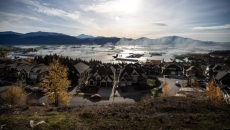
Several communities in B.C. woke to smoke-filled skies Wednesday as wildfires burn in the Interior and across the border in Alberta.
In a special air-quality statement, Environment Canada and the B.C. Ministry of Environment and Climate Change Strategy said several Interior communities are likely to see worsening smoke over the next 24 to 48 hours.
Observed conditions in Kamloops, Prince George, Williams Lake, Fort St. John and Quesnel showed high-risk or very high-risk readings on the Air Quality Health Index Wednesday morning.
Mehta said it was "flabbergasting" to see people engaged in a range of outdoor activities in Kamloops Wednesday, despite the pall of smoke over the city.
He said it's particularly challenging to communicate the health hazards tied to wildfire smoke, which have descended on Kamloops and other communities weeks earlier than in past seasons, which he said is a "troubling" development.
"I saw people jogging, cycling, a lot of elderly people that were going for their regular walks like it was just an everyday day," he said.
The BC Lions moved their training camp indoors because of the smoke in Kamloops.
Mehta said people of all ages are negatively affected by wildfire smoke exposure, elevating the risk of strokes and a host of other health problems.
He said he worries about people of all ages, from his students to older people re-evaluating plans to retire in Kamloops because of the yearly wildfires.
Mehta said 2017 and 2021 were particularly bad years for wildfire smoke in Kamloops.
"I remember in 2017 when we had levels that are triple what they are today and truly unprecedented territory," he said. "In 2017, it was for six to seven weeks straight in the Interior, risks were incredibly high, not even quantifiable based on the models that are available, and we still had all these public events."
Mehta said he faced a backlash when he opposed holding a public event known as Rib Fest on the streets of the city on what he said was a dangerously smoky day.
He said there were numerous comments on social media and "nasty phone calls and letters" about his suggestion to reschedule the event.
"It was just unbelievable, the attack," he said. "It is very difficult to be one of the few people actually warning people about these sorts of things."
Environment Canada's air quality statement says wildfire smoke is hazardous to health even at low concentrations, and urges at-risk people, including children, the elderly and people with lung conditions, to avoid strenuous outdoor activities.
The Metro Vancouver Regional District issued its own air quality advisory on May 15, but ended it Tuesday saying cooler temperatures and favourable winds improved conditions in the region's northeast and in the Fraser Valley.
Mehta said Wednesday that even staying indoors during hazy, smoky days doesn't necessarily provide protection from harmful smoke particles, and said widespread adoption of HEPA filters and mask use are important additional measures.
"Once we understand that this isn't benign, but there are these hundreds of chemicals out there, we can start to change the way we think about it," he said. "If we can crack this nut, if we can figure out how to activate people to protect themselves on this issue, I think it'll be a lot easier going forward with other kinds of things like future pandemics and stuff like that, so yeah, it's pretty important to get it right."