Friday, June 19, 2026
ADVT 
National

Spy service to get stronger anti-terror powers under federal bill

Darpan News Desk The Canadian Press, 30 Jan, 2015 10:49 AM

    OTTAWA — Newly tabled anti-terrorism legislation would give Canada's spy agency more power to thwart a suspected extremist's travel plans, disrupt bank transactions and covertly interfere with radical websites.

    The plan to boost the Canadian Security Intelligence Service's ability to counter terrorist threats flows from a review of fatal attacks on two Canadian soldiers last October — incidents the government believes were fuelled by Islamic extremism.

    As expected, the bill would also make it easier for the RCMP to obtain a peace bond to restrict the movements of a suspect and it extends the period for preventative arrest and detention.

    In addition, the legislation would expand the no-fly regime to cover those travelling by air to take part in terrorist activities, whereas currently there must be an immediate risk to the plane.

    The bill proposes giving the RCMP power to seek a judge's order to remove terrorist propaganda from the Internet.

    It would also create a new criminal offence of encouraging someone to carry out a terrorism attack.

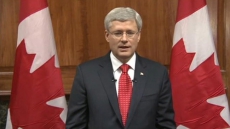
    Prime Minister Stephen Harper told a gathering in Richmond Hill, Ont., that his Conservative government is prepared to both condemn and confront terrorism.

    "Jihadist terrorism is not a future possibility, it is a present reality," Harper said.

    "It seeks to harm us here in Canada, in our cities and in our neighbourhoods through horrific acts."

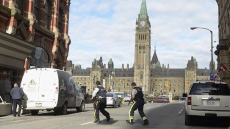
    On Oct. 22, Michael Zehaf Bibeau shot Cpl. Nathan Cirillo, an honour guard at the National War Memorial, before rushing into Parliament's Centre Block. Zehaf Bibeau was quickly gunned down.

    Two days earlier, Martin Couture-Rouleau had fatally rammed Warrant Officer Patrice Vincent with a car in St-Jean-sur-Richelieu, Que. After a chase, police shot and killed the knife-wielding assailant.

    It soon emerged the RCMP had been monitoring the man — who harboured jihadist sympathies — for months.

    The Mounties even prevented him from travelling overseas, presumably to join militant fighters. But they did not have enough evidence to arrest him or further limit his movements, saying extreme beliefs were not a crime.

    Existing law requires a fear that someone "will commit" a terrorism offence before police can obtain a peace bond — a tool that can mean jail unless a suspect abides by strict conditions, for instance that they surrender their passport and regularly report to police.

    The new, lower threshold would be reasonable grounds to fear a person "may commit" a terrorism offence.

    Current anti-terrorism law allows police to arrest someone without a warrant and hold them for up to three days before a hearing. Under the bill, maximum period would be extended to seven days.

    Other proposed measures would:

    — Allow for more information-sharing when the material — such as passport or immigration information — is relevant to an agency's national security mandate;

    — Give the government more power to object to disclosure of classified information in immigration proceedings.
    MORE National ARTICLES

    Two Men Face Charges More Than Three Years After Stanley Cup Riot

    Two Men Face Charges More Than Three Years After Stanley Cup Riot
    VANCOUVER - Charges are still being laid against people accused of being involved in Vancouver's Stanley Cup riot more than three years after crowds looted stores, overturned cars and set fires.

    Two Men Face Charges More Than Three Years After Stanley Cup Riot

    Magnotta jury watches original images used to create Lin murder video

    Magnotta jury watches original images used to create Lin murder video
    MONTREAL - Jurors at Luka Rocco Magnotta's murder trial have viewed more disturbing unedited photos and footage used to make the so-called video of the dismemberment and desecration of Jun Lin in May 2012.

    Magnotta jury watches original images used to create Lin murder video

    Ottawa police say only one gunman involved in Wednesday's shootings

    Ottawa police say only one gunman involved in Wednesday's shootings
    OTTAWA - Ottawa police are now saying they believe only one gunman was involved in Wednesday's shootings at the National War Memorial and on Parliament Hill.

    Ottawa police say only one gunman involved in Wednesday's shootings

    Factbox: Canada's past includes shooting at Quebec's National Assembly in 1984

    Factbox: Canada's past includes shooting at Quebec's National Assembly in 1984
    A gunman killed a soldier at the National War Memorial on Wednesday before being shot in Parliament Hill's Center Block. Prime Minister Stephen Harper said the attack will harden Canada's resolve to crack down on terrorists at home and abroad. Here are some past terrorism cases and terrorism allegations, as well as cases in which politicians or legislatures were attacked or such attacks were allegedly plotted:

    Factbox: Canada's past includes shooting at Quebec's National Assembly in 1984

    Tighter security imposed at New Brunswick army base following Ottawa shooting

    Tighter security imposed at New Brunswick army base following Ottawa shooting
    OROMOCTO, N.B. - Tighter security measures have been imposed at 5th Canadian Division Support Base Gagetown in New Brunswick as a result of recent violent acts against Canadian Forces members in Quebec and Ontario.

    Tighter security imposed at New Brunswick army base following Ottawa shooting

    Text of Prime Minister Stephen Harper's address on the Ottawa shootings

    Text of Prime Minister Stephen Harper's address on the Ottawa shootings
    OTTAWA - Prime Minister Stephen Harper delivered a broadcast address on the shootings in Ottawa on Wednesday. Here is the text of his remarks:

    Text of Prime Minister Stephen Harper's address on the Ottawa shootings