

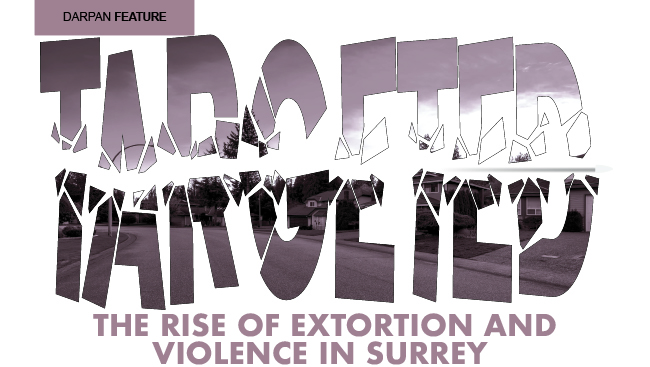
Fear and frustration are rising across Surrey as an alarming wave of extortion, gang violence, and public shootings shakes the city’s South Asian community.
With reported extortion attempts nearly tripling since June, the situation has become a matter of urgent and serious alarm.
British Columbia (B.C.) Premier David Eby and Surrey Mayor Brenda Locke have both urged Prime Minister Mark Carney to designate extortion gangs as terrorist entities under Canadian law. Eby called for the India-based Lawrence Bishnoi gang to be labeled a terrorist group, citing its links to a wave of extortion, shootings, and arsons targeting South Asian communities across B.C., Alberta, and Ontario. Echoing the sentiment, Mayor Locke joined calls for the federal government to recognize the Bishnoi gang—and any other groups involved in extortion and violence targeting Canadians of South Asian descent—as terrorist organizations.
With overseas operatives and ties to high-profile crimes, officials warn the network is too complex for traditional policing alone. This warning resonates most strongly in Surrey, where the impact is being felt acutely. At the forefront of public concern are extortion attempts targeting South Asian business owners. Initially reported to be 10 mid-year, Surrey Police Service (SPS) confirmed the number had risen to 26 as of August 2025. These extortions often begin with anonymous threats via phone or social media, followed by demands for large sums of money and threats of violence if the demands are not met. Police believe the true number is likely much higher, as fear and stigma prevent many victims from coming forward.
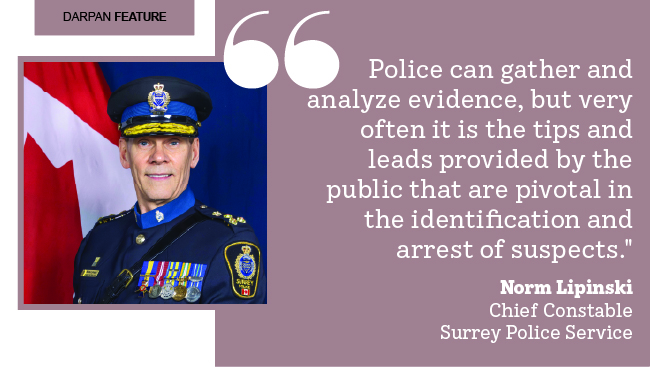
Chief Constable Norm Lipinski of SPS stresses the crucial role of public cooperation in solving these crimes: “Police can gather and analyze evidence, but very often it is the tips and leads provided by the public that are pivotal in the identification and arrest of suspects.” SPS has established a dedicated Extortion Investigation Team and is collaborating with other law enforcement agencies through a Joint Force Operation led by the RCMP Lower Mainland District.
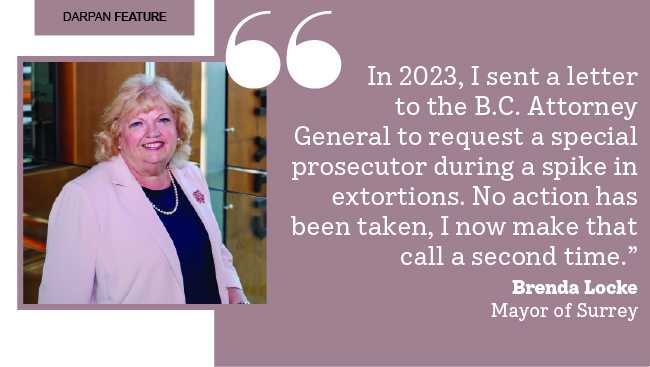
Mayor Locke is renewing her demand for a special prosecutor to be assigned to fast-track extortion cases. “In 2023, I sent a letter to the B.C. Attorney General to request one during a spike in extortions. No action has been taken,” she says. “I now make that call a second time.” She also criticizes delays in the justice system that prevent police from laying charges directly, keeping suspects on the streets longer. Meanwhile, Mayor Locke assures that Surrey is ramping up safety efforts with upgraded surveillance at 600+ intersections and a new Public Safety Department to support investigations.
MP Sukh Dhaliwal of Surrey Newton calls for a collaboration between law enforcement agencies at all levels: "No one should have to live or work in fear. Federal, provincial, and local governments each have a critical role. We must not allow fear to dictate our daily lives.
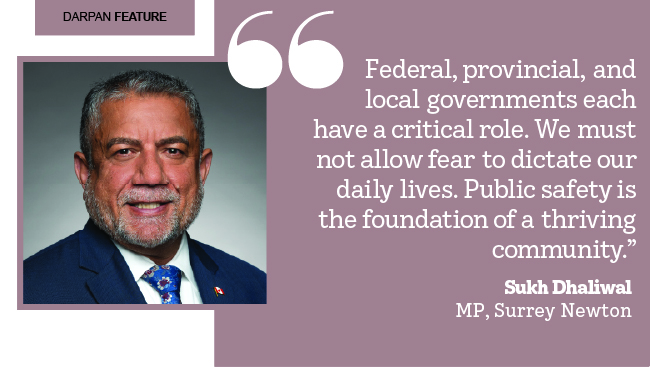
Public safety is the foundation of a thriving community.” Dhaliwal highlights recent federal efforts, including Motion M-112 and Bill C-70, aimed at improving intelligence coordination and bolstering tools to fight foreign interference—some of which may overlap with organized crime.
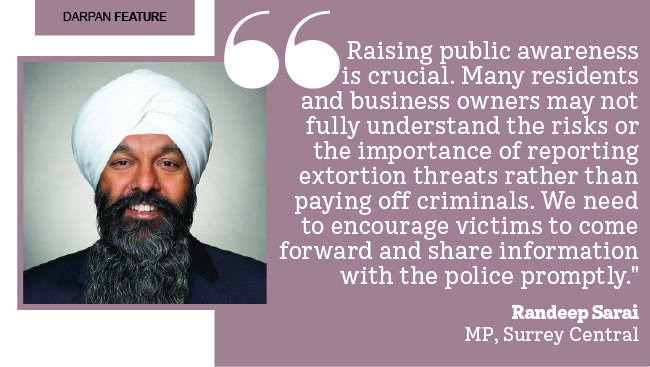
Meanwhile, MP Randeep Singh Sarai shines light on public education and trust-building as equally vital tools: “Raising public awareness is crucial. Many residents and business owners may not fully understand the risks or the importance of reporting extortion threats rather than paying off criminals. We need to encourage victims to come forward and share information with the police promptly. This helps law enforcement identify patterns, intervene early, and dismantle these criminal enterprises before they escalate.” Sarai details recent meetings with senior RCMP and government officials to discuss enforcement and prevention, as well as calls for modernizing Canada’s criminal laws to better address international crime networks.
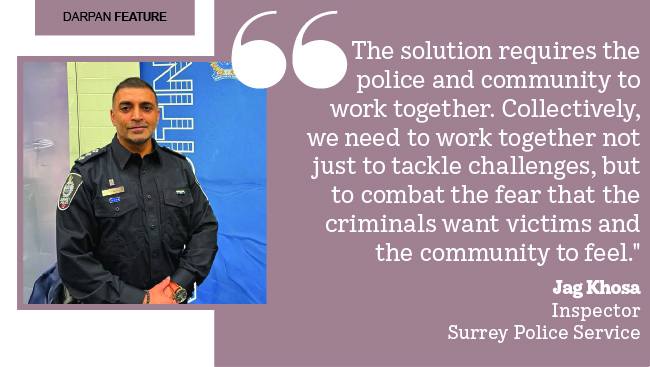
Inspector Jag Khosa of the SPS adds that fear alone is not the answer. “Fear is a reaction; it isn’t a solution,” he points out. “The solution requires the police and community to work together, to strengthen the relationship and lines of communication. Collectively, we need to work together not just to tackle the challenges, but to combat the fear that the criminals want victims and the community to feel. They need to see that the people, businesses, and communities that they are trying to threaten and intimidate are actively working together to resist and defeat them.”
The public safety crisis is further complicated by larger policy debates. Critics say that soft immigration policies have allowed troublemakers to enter Canada and embed themselves in diasporic communities.
Mayor Locke echoes this frustration in a letter to the Prime Minister calling for enhanced intelligence-sharing, faster extradition processes, and stronger legal tools. She urges Canada to consider laws similar to the U.S.'s RICO Act to better prosecute organized crime functioning as multinational enterprises.
Evidently, the real-world consequences of this violence go beyond fear. Business owners, already grappling with rising costs and post-pandemic recovery, are now forced to make difficult decisions. Some have installed security systems, while others are quietly considering relocating or shutting down. Yet amid the fear, there are glimmers of resolve, propelled by community leaders.
Lipinski warns that perpetrators often try to divide communities by exploiting ethnic or religious differences. “Police and the community must band together to resist the push for division, support victims, and counteract the fear by identifying the suspects and the groups they work for,” he emphasizes.
Surrey finds itself at a critical crossroads. As authorities ramp up investigations and political support is sought, the community faces a choice between retreating in fear or confronting these challenges with solidarity. For many, the choice is clear. Whether it's a city councilor calling for judicial reform or a local shopkeeper refusing to pay a bribe, the message is the same: Surrey will not be intimidated.


