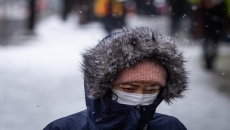
SURREY, B.C. - British Columbia is warning drivers to prepare winter survival kits as a blast of frigid cold hits over the next week and the mercury plummets across the province.
Temperatures over the next week are forecast to be five to 10 degrees Celsius below normal for the South Coast and Haida Gwaii, and 10 to 20 degrees below normal for the Interior and the North.
In parts of the North and Yukon, daytime maximum temperatures are forecast to be below -30 C by Wednesday.
B.C.'s Ministry of Emergency Management and Climate Readiness says in a statement that local warming centres may be opened to protect vulnerable populations and emergency shelter spaces are also available for people in need of a warm, safe place.
Drivers are being asked to check the forecast and be prepared by having a full tank of fuel and packing a winter survival kit including a snow brush, flashlights and first aid supplies.
"Drivers are reminded to plan ahead and drive according to weather and road conditions. Commuters should be prepared for delays and potential service disruptions on transit routes," the statement says.
It says provincial roads will be brined and if weather conditions worsen, drivers should stay off the road.
Vancouver is expecting a combination of rain and snow over the weekend and throughout much of next week, with a daytime maximum of -5 C on Tuesday.
Environment Canada says nearly five centimetres of snow is possible over Metro Vancouver on the weekend.
A bigger dump of up to 25 cm blanketed the south coast and Vancouver Island at the end of November, leading to rush-hour crashes that blocked major roads and cut power for nearly 100,000 BC Hydro customers, and causing a plane to skid off a taxiway at Vancouver International Airport.
Surrey city councillor Linda Annis was one of those trapped in the Nov. 29 gridlock. She says it took her nine and a half hours to get from Vancouver to South Surrey.
"(It was a) very, very long, frustrating trip. And for me, I quickly realized that I had no way to get home. All the access points to going over the Fraser River were closed or were stuck with vehicles," she said.
Annis and New Westminster city councillor Daniel Fontaine are calling for a "snow summit" to come up with ways to avoid a repeat. They want to involve the province, Metro Vancouver, municipalities, first responders and road maintenance contractors.
Annis said there needs to be a united approach to snow that includes better communication with the public and possibly snow driving clinics run by the Insurance Corporation of B.C.
"Because clearly in Vancouver, we're not very good at it. And you know, we don't get it often enough to really become experienced," she said.
Annis and Fontaine wrote to Transportation and Infrastructure Minister Rob Fleming and the chair of Metro Vancouver's regional district pitching the idea last week but have yet to hear back.
The Ministry of Transportation and Infrastructure says in a statement it is aware of the request, but neither it nor Fleming had been formally invited to participate.
The ministry says it reviewed its response to the November snowfall and has worked with Lower Mainland contractors to improve deployment of plow and tow trucks.
"Ministry staff have also already reached out to their counterparts in Lower Mainland municipalities to discuss winter weather response, strengthen communication lines, and share information on our level of preparedness based on available weather forecasts," it says.
Environment Canada, meanwhile, says in a special weather statement for Yukon and northern B.C. that arctic air that will be accompanied by gusty northerly winds and the threat of bitterly cold temperatures and dangerous wind chill values.
The statement covers B.C. communities including Atlin, Dease Lake and Fort Nelson, where a maximum temperature of -31 C is forecast by Wednesday.