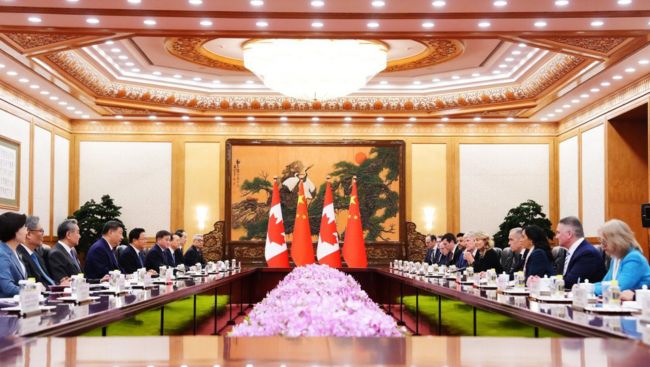
Prime Minister Mark Carney said Friday he found "much alignment" between his views on Greenland's sovereignty and those of Chinese President Xi Jinping in response to U.S. President Donald Trump's threats against the territory.
"I had discussions with President Xi about the situation in Greenland, about our sovereignty in the Arctic, about the sovereignty of the people of Greenland and people of Denmark, and I found much alignment of views in that regard," Carney said at a press conference in Beijing.
Carney said Canada's position is that Greenland, a semi-autonomous territory of Denmark, should determine its own future.
Noting that Denmark is a NATO ally, Carney said "our full partnership stands, our obligations under Article 5, Article 2 of NATO stand and we stand full square behind those."
Article 5 is the alliance's collective defence agreement, which states that an attack on one member constitutes an attack on all. It has only been invoked once in NATO's 75-year history — by the U.S. after the 9/11 attacks.
Trump insists the U.S. needs control of Greenland for national security reasons and has said he would take it over "whether they like it or not."
On Friday, he told reporters he's considering imposing tariffs on countries that oppose his plans for Greenland.
Secretary of State Marco Rubio has said the U.S. would like to buy the island, something officials in both Greenland and Denmark have said is not going to happen.
Denmark's Prime Minister Mette Frederiksen has said an American takeover of the island would mark the end of NATO.
Trump also has claimed that if the U.S. doesn't have control of Greenland, Russia or China would try to take it over. Arctic experts say that claim is false.
China, which views itself as a "near-Arctic state," has taken an increasingly aggressive posture in the region that includes joint military exercises with Russia near Canadian territory and around Alaska.
Canada's latest defence policy warns of Chinese and Russian ambitions in the Arctic and says China's interests "increasingly diverge from our own on matters of defence and security."
That policy was released in May 2024, before Carney came to office and began a major reset of relations with China.
He told reporters Friday that his government has increased Canada's military presence in the Arctic "to 365 days a year on land, sea, and in the air."
Several European countries have recently sent troops to Greenland in response to Trump's threats, in co-ordination with Denmark.
The office of Defence Minister David McGuinty has not answered questions about whether any Canadian military personnel are in the territory.
"While the Canadian Armed Forces are not initiating any new operations at this time, we have several joint operations with European allies, including in Greenland," said spokesperson Maya Ouferhat in an emailed statement.
Carney said Canada and Denmark are working together through NATO and the Nordic-Baltic Eight group, and noted Ottawa plans to formally open a consulate in Greenland's capital Nuuk next month.
Carney's meeting with Xi in Korea in October and his trip to Beijing this week were the first interactions between the leaders of the two countries since 2017.
A statement released by the Prime Minister's Office after the meeting said Canada and China are "both strong advocates of multilateralism."
After the bilateral meeting, Carney announced the two countries cut a deal to dramatically reduce their respective tariffs on Chinese electric vehicles and Canadian agriculture products.
Picture Courtesy: THE CANADIAN PRESS/Sean Kilpatrick