

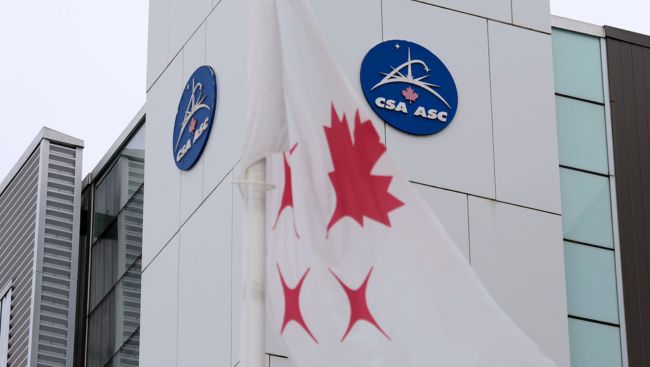
Canadians passionate about their country's role in space say investments in homegrown astronauts and businesses are vital in inspiring the nation's future steps to the stars — and the benefits that come with it.
The space sector contributed $3.4 billion to Canada’s gross domestic product in 2024, according to government figures. The federal government has also invested billions of dollars across the sector and positioned itself as a key partner to NASA and the European space effort.
However, Toronto-born astrophysicist Sara Seager, a renown researcher and professor at the Massachusetts Institute of Technology, says Canada needs to replicate the U.S. approach of “thinking big” when it comes to space.
“I don’t always mean just spending huge amounts of money but making opportunity, taking risks — just executing on what appears to be a crazy idea,” Seager said in a recent interview.
Known for her work as a planetary scientist, Seager earned her bachelor's degree in mathematics and physics from the University of Toronto before moving to the U.S. to acquire her doctorate in astronomy in 1999.
She was granted the honour of officer of the Order of Canada in October 2020 for her work as a pioneer in the study of planets outside our solar system and has led several NASA projects related to her research.
Seager said she’s returning home this September to work for the U of T's Canadian Institute for Theoretical Astrophysics, in part, to “help build the momentum in this shift.”
“And, although there has to be money behind the opportunity, it's part of the culture of trying things, of doing hard things, of doing ambitious things.”
She pointed to Kepler Communications as an example of a homegrown space sector innovation. The Toronto company says its goal is to build stable internet for space that will enable better celestial communications.
But Seager says it's also important for Canada to invest in those that can inspire others.
Jeremy Hansen, who grew up on a farm outside London, Ont., became the first Canadian — and non-American — to travel beyond low Earth orbit and journey thousands of kilometres to the vicinity of the moon last week.
Those kind of accomplishments have a practical benefit, Seager says, because they inspire Canadians to enter and make advancements in science, technology, engineering and medicine.
"We need inspiration ... we've got to attract more people and get our pipeline, our workflow, our people getting trained to work in STEM fields," she added.
Zainab Azim's father said he wanted her and her brother to be the youngest ever astronauts when he spent half a million dollars in 2014 to secure a seat for them on a commercial space flight.
Azim, then 11 years old, told CBC News from her hometown of Milton, Ont., that one of her career goals was to be an astronaut.
Now age 23, Azim says she still has her $250,000 Virgin Galactic ticket and wouldn’t turn down donning a space suit like Capt. Chris Hadfield, one of her inspirations.
But Azim, who teaches economics policy as a teaching fellow at Harvard University, says she's shifted her focus to advocating for equality and opportunity in STEM fields.
“It shouldn't just be based on luck of where you're born and having a supportive infrastructure around you,” said Azim, who was previously a mentor with the UN's Space for Women initiative.
“You should be able to pursue those opportunities if you wanna do it for the right reasons in this country.”
Azim, who recently moved back to Canada, said the key driver to funding space advancements should be the positive symptoms it provides to humanity, as opposed to intergalactic conquest.
“We have these satellite systems because of our space programs that can identify where is the best place to grow these crops, to increase the yield so that we can feed more people,” she said.
“That is a direct benefit of space for people on Earth.”
Azim added the Artemis II program was an example of space diplomacy that Canada needs to remain a part of.
"The U.S. is literally talking about annexing Canada and we were able to work on a mission together to get people back to the moon," she said, referencing U.S. President Donald Trump's previous threats to make Canada the 51st state.
"It shows what is possible."
In a recent major investment in the domestic space sector, the federal government in March announced it was putting $200 million toward a Canadian-owned launch pad that will send satellites into orbit.
A 10-year lease of Maritime Launch Services' infrastructure will give Canada the ability for the first time to launch space projects on its own. The launchpad in Canso, N.S., is expected to be operational by the end of 2026, according to the company, while Ottawa is targeting 2028 for domestic launch capability.
Sarah McLean, vice president of corporate affairs for Maritime Launch, says having space independence enabled by companies like her own is critical for Canada’s cosmic future.
“Humanity engages with space on a daily basis — whether we're picking up our iPhone or doing banking, monitoring weather, making weather predictions,” McLean said.
“So investing, whether it's time or money in space is no longer optional, it's necessary and strategic.”
Seager, whose research has contributed to the search for alien life, says Canada needs to remain involved in both exploratory space travel and the business sector that supports it.
"Where the space is economy is going, we don't exactly know. But it's definitely going somewhere and we want to be a part of it."
Picture Courtesy: THE CANADIAN PRESS/Justin Tang


