Sunday, June 28, 2026
ADVT 
National

This Indo-Canadian's UBC Research Team Can Transform Different Blood Groups Into One Universal Type

Darpan News Desk IANS, 30 Apr, 2015 10:04 AM
    Canadian researchers, including one of Indian origin, have now developed a way to transform all donated blood into a neutral type that can be given to any patient.
     
    The researchers have created an enzyme that could potentially pave the way for changing blood types.
     
    The enzyme works by snipping off the sugars, also known as antigens, found in Type-A and Type-B blood, making it more like Type-O.
     
    Type-O blood is known as the universal donor and can be given to patients of all blood types.
     
    With this enzyme, Jayachandran Kizhakkedathu from the University of British Columbia and colleagues were able to remove the wide majority of the antigens in Type-A and B blood.
     
    "We produced a mutant enzyme that is very efficient at cutting off the sugars in A and B blood, and is much more proficient at removing the subtypes of the A-antigen that the parent enzyme struggles with," said lead author of the study David Kwan from the University of British Columbia in Canada.
     
    To create this high-powered enzyme capable of snipping off sugars, researchers used a new technology called directed evolution that involves inserting mutations into the gene that codes for the enzyme, and selecting mutants that are more effective at cutting the antigens.
     
    In just five generations, the enzyme became 170 times more effective.
     
    While the researchers were able to remove the wide majority of the antigens in Type-A and B blood, before it can be used in clinical settings, the enzyme used would need to remove all of the antigens.
     
    The immune system is highly sensitive to blood groups and even small amounts of residual antigens could trigger an immune response.
     
    The findings appeared Journal of the American Chemical Society.

    MORE National ARTICLES

    New Brunswick voters go to polls Monday, jobs big issue in 32-day campaign

    New Brunswick voters go to polls Monday, jobs big issue in 32-day campaign
    FREDERICTON - Voters in New Brunswick go to the polls today after a 32-day election campaign that has been fought on job creation and economic development.

    New Brunswick voters go to polls Monday, jobs big issue in 32-day campaign

    B.C. Schools Back In Session After Weeks Of Delay

    B.C. Schools Back In Session After Weeks Of Delay
    VANCOUVER - Many parents and students in B.C. are relieved school is finally starting on Monday after three weeks of delay, and some say there is even a silver lining to the provincewide teachers strike.

    B.C. Schools Back In Session After Weeks Of Delay

    Plan To Revoke Canadian Passports Raises Concerns

    Plan To Revoke Canadian Passports Raises Concerns
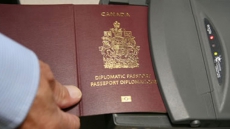
    MONTREAL - A human rights lawyer is raising concern about the federal government's plan to strip Canadian passports of those suspected of travelling abroad to join extremist groups.

    Plan To Revoke Canadian Passports Raises Concerns

    Activists Rally Against Climate Change In B.C.

    Activists Rally Against Climate Change In B.C.
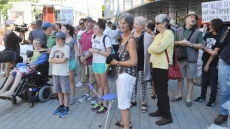
    VANCOUVER - Hundreds marched through downtown Vancouver on Sunday in support of a United Nations meeting that hopes to stifle climate change.

    Activists Rally Against Climate Change In B.C.

    New Brunswick Voters Go To The Polls

    New Brunswick Voters Go To The Polls
    FREDERICTON - After a 32-day election campaign fought largely on jobs, voters in New Brunswick decide Monday between a Liberal plan to turn the economy around through government stimulus or a Progressive Conservative promise to allow greater development of the province's natural resources.

    New Brunswick Voters Go To The Polls

    Why Winnipeg? How Canada's National Lab Became An Ebola Research Powerhouse

    Why Winnipeg? How Canada's National Lab Became An Ebola Research Powerhouse
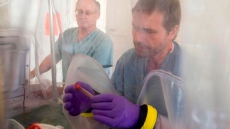
    When Dr. Frank Plummer talks about the first experimental Ebola drug used in an outbreak, he pronounces it "Zed Map." "I do it consciously," says Plummer, who retired this year after serving for nearly 14 years as the head of Canada's National Microbiology Laboratory in Winnipeg.

    Why Winnipeg? How Canada's National Lab Became An Ebola Research Powerhouse