Infectious disease experts and COVID-19 modelers are sounding alarm bells of an approaching third wave expected to be driven by more contagious variants of the virus.
But while we brace for Wave 3, some are wondering if we ever actually cleared Wave 2, especially in populous areas of the country where transmission has remained more steady.
Experts say the definition of what constitutes a "wave" and pinpointing when it's passed isn't so clear.
Some say we're on the tail end of the second wave now, as evidenced by the downward trend of cases across the country, while others say ebbs and flows haven't been uniform enough to determine when one wave ends and another begins.
Caroline Colijn, a COVID modeler and mathematician at Simon Fraser University, says the word "wave" has been somewhat misleading. Waves of viruses tend to ease up on their own as immunity grows within a population, she says, which we haven't reached yet with COVID.
Instead, the ebb and flow of SARS-CoV-2 has been dictated by our own actions, Colijn added, for instance restrictive measures that limit the ability of the virus to spread.
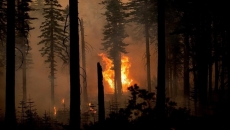
"This isn't a wave, it's a forest fire," Colijn said. "We turn the hoses off and the flames build up again and we get exponential growth. Then we turn the hoses back on and cases decrease."
Colijn, whose modelling predicts steep rises in cases around the end of February in six of Canada's biggest provinces, says the challenge of "wave language" is that when waves recede, people think the threat has ceded with it.
But until we reach levels of herd immunity, she says, that's not going to happen.
"We're not seeing a natural tailing off. We're seeing things drop because of restrictions — those fire hoses we put in front of the fire," she said. "Then we turn the hoses off and we're surprised that this wave is coming back."
Canada's top doctors said Friday that eight provinces have reported cases of new COVID variants, with three of them showing evidence of community transmission.
Chief public health officer Dr. Theresa Tam said there had been 429 cases of the variant first identified in the U.K., 28 cases of the variant first identified in South Africa, and one of the variant first found in Brazil.
While it sounds like a small number compared to our population, University of Manitoba virologist Jason Kindrachuk says the heightened transmissibility of those variants makes the situation more alarming.
Compounding things further is that true prevalence of the variants nationwide is unknown, he added, though some jurisdictions have been doing point-prevalence studies to help determine that.
Kindrachuk says one or two cases, when caught early and isolated, aren't too concerning. But danger proliferates as more pop up.
"You have that initial fire and then sparks start flying ... and that leads to a bunch of small fires," he said. "If those start to catch, you lose the ability to necessarily keep things in control."
Dr. Howard Njoo, Canada's deputy chief public health officer, says the presence of more transmissible variants means people should be more diligent in adhering to current safety measures aimed at slowing the spread of other COVID strains, including limiting contacts, mask-wearing and distancing.
The spike in variant cases comes at a time when Canada appears to be "two-thirds of the way down the curve," Tam said, as overall COVID cases fall.
Some jurisdictions, like Ontario, have taken that as reason to reopen. Most of the province is moving away from its stay-at-home orders next week, even though projections released Thursday show a potentially rapid rise by late February.
Dr. Andrew Morris, an infectious disease expert with the University of Toronto, says reopening Ontario now could lead to further lockdowns in the province later.
"I anticipate our numbers over the next two weeks are going to be pretty good, but it's four weeks from now, six weeks from now that I'm most concerned about," he said.
Troy Day, a COVID modeler out of Queen's University, says the problem with the variants is that they're still lurking beneath the surface. And they may not truly be seen until they take hold more firmly.
Day said he's concerned about a third wave in Canada because places like Britain have shown similar trajectories.
"Cases go down and you think everything's OK, but underneath is actually an increase in variant cases that will eventually dominate everything," he said.
Day says the word wave is "funny terminology," adding he's been hesitant to definitively label the ups and downs of COVID case counts that way.
"All the waves we've seen are driven largely by what we're doing to control it," Day said. "The more we open up and shut down, the more multiple waves we'll have."