The head of a Germany company bidding to win Canada's lucrative submarine contract said it is possible to build its submarines, or part of them, in Canada — but probably not any time soon.
If Ottawa wants anything like that baked into a deal for the Royal Canadian Navy's next fleet of patrol submarines, it should come at the end of the contract, many years down the line, to mitigate risks to the major, multi-billion dollar procurement project.
"If Canada wants to go this way, then it's my task to show them," Thyssenkrupp Marine Systems CEO Oliver Burkhard told The Canadian Press in an interview.
He said his company is setting up domestic production in India for six subs of another type designed by the German firm, since the government was after local shipbuilding benefits under its domestic production strategy.
Although, that doesn't mean the same would happen here.
"It's difficult — you cannot ramp it up from today to tomorrow, saying, 'Now we're building submarines, let's go," he said.
Other such production possibilities include domestic part production that could feed submarine supply lines.
Burkhard said he heard a range of opinions on such ideas over several days of meetings with Canadian officials this week, but added it's not up to him to tell Canada how to go about shopping for its next fleet of submarines — the customer is always right.
As Canada hunts for a supplier, the navy is in a race against time to replace its four aging Victoria class submarines that will all retire by 2035. Ottawa is at the same time looking for ways to build up the domestic defence industry.
Submarines are complex machines that experts have compared to building a space rocket. Only some countries make them, and Canada is not one of them. The country hasn't assembled submarines domestically since before the Cold War and has never designed its own.
Nor has the federal government sent signals publicly if building them at home is something it would seriously want to pursue.
Paul Mitchell, a professor of defence studies at Canadian Forces College, said domestic manufacturing would likely require massive investment and wouldn't happen quickly, if it does at all.
"That would take some time because the skill sets for constructing submarines are highly specialized," he said, noting it involves special types of steel and welding techniques not used in common commercial applications.
"You're probably going to try to lure people away from other things like the shipbuilding that's going on on the West Coast with Seaspan, or other areas where the national ship building strategy is in play, the oil patch — all of those sorts of things," he said.
But he said the fact that the company is open to this underscores the fierce and heated competition for the lucrative sub contract.
"Given the scale of the contract, both companies are competing mightily to try to attract the government in terms of the industrial benefits they're going to accrue from this project," Mitchell said.
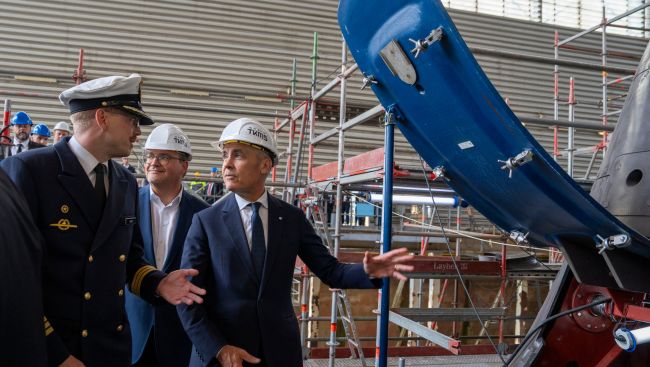
When Prime Minister Mark Carney visited the company's shipyard in Kiel, Germany in August, he announced TKMS was one of two finalist bidders, along with South Korea's Hanwha.
Hanwha Oceans is similarly pitching Ottawa on various industrial-technological collaborations, which could involve investments in Canadian lithium-ion battery production, liquefied natural gas, aerospace and steel — along with building "sustainment" facilities for its KSS-III on both coasts.
Hanwha is also keeping its cards close to its chest, although has suggested an order of 12 of its subs could cost Canada in the ballpark of $24 billion, and has proposed the most rapid delivery timeline.
TKMS representatives were visiting Ottawa for several days of meetings with key Canadian ministers and MPs — something Burkhard compared to marathon speed dating — as part of a German-Norwegian delegation visiting the capital looking to sell Canada on joining the multinational submarine alliance.
Some of those decision makers included Secretary of State for Defence Procurement Stephen Fuhr, Natural Resources Minister Tim Hodgson and Industry Minister Melanie Joly.
Germany and Norway have purchased 12 of TKMS' 212CD submarines, and the main marketing pitch being delivered, and repeatedly underscored, is interoperability with partner nations using the same subs.
Germany's defence minister Boris Pistorius said on Tuesday if Canada joins its submarine partnership with Norway, the three countries could pool shipyard resources and parts.
The charm offensive comes just ahead of Carney paying a trip to Asia in the coming days, where he is expected to tour a Hanwha shipyard.
Burkhard said the focus of his conversations with Canada have shifted toward industrial benefits to Canada, and he is getting clear signals.
"We fully understood that submarine building is nation building, so there has to be more benefits in that," he said. "We're not talking at the moment about technical capabilities, it has shifted to more economic arguments of what's beyond (the submarines)."
He said behind-the-scenes discussions include co-operation in energy, mining, aerospace and artificial intelligence. AI plays a major role in modern submarines.
Some of the industrial benefits, should it win the contract, would be negotiated government-to-government with Germany, but the company itself can sweeten its offer — something common in such massive military procurement purchases.
For example, Burkhard noted the engine comes from Siemens, so that's a company he could approach with an offer to cooperate on Canadian industrial benefits by making something domestically as a contract addition.
"We're used to it, and I think we know what we're doing there," he said.
Burkhard would not reveal specifics of what's being negotiated or disclose a price range, since he doesn't want to give any hints to his competitor and said it's still not yet clear what exactly Canada wants on board the war machines.
While industrial benefits and trade, delivery schedules, military alliances and the submarine capabilities will all drive comparisons between the two defence manufacturers, Mitchell said the big question for him is about ensuring Canada can sustain and support them over the long term — and the more established TKMS could turn that into a real edge.
"Even though they've got a slower delivery cycle than what Korea is promising, clearly (the Germans) have demonstrated over the last 30 or 40 years the ability to support multiple navies on a global basis," he said.
"Anybody can buy a submarine if you've got enough money. But can you keep it at sea? That's the real acid test here, and the ability to keep these things at sea was the stuff that failed with the Victoria class."
Picture Courtesy: THE CANADIAN PRESS/Christinne Muschi