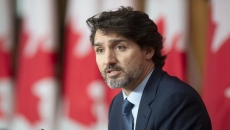
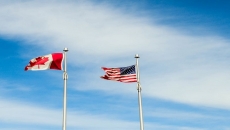
Prime Minister Justin Trudeau and President Joe Biden will discuss plans to reopen the Canada-U.S. border when they meet on the margins of the G7 summit, a New York congressman said Thursday amid ongoing pressure to further ease travel restrictions.
The White House said the pair, who are in the United Kingdom for the three-day summit that gets underway Friday, will discuss the matter before the weekend, Rep. Brian Higgins told a panel discussion hosted by the Tourism Industry Association of Canada.
"I have confirmed from the White House last night that U.S. President Biden and Canadian Prime Minister Justin Trudeau are going to meet either later (Thursday) or (Friday) on this issue," said Higgins, who has been one of the most vocal American champions of reopening the border.
"In the end, these are the only two decision-makers that matter. They can make a game-changing decision; this could be an inflection point."
Alongside Higgins on the panel was Liberal MP Wayne Easter, a fellow co-chair of the bilateral committee known as the Canada-U.S. Inter-Parliamentary Group and himself a recent champion of accelerating efforts to relax the limits on travel at the shared border.
On Wednesday, the federal Liberal government said that by early July, Canadian citizens, permanent residents and essential workers who have had a full course of a COVID-19 vaccine will no longer be automatically required to spend 14 days quarantining upon their arrival in Canada.
Eligible travellers will be tested when they arrive and able to leave isolation once their test comes back negative. The government will also exempt eligible and fully vaccinated travellers from having to spend their first three days in a federally approved hotel.
None of that goes far enough, Easter said: "In my view, we have to go farther than who is currently permitted."
Fully vaccinated seasonal residents — U.S. citizens who own property in Canada — should be allowed in, given the role they play in the regional economy and the local community, he said.
"They can come in a safe fashion, they can add to our economy, they're going to renovate their seasonal residences, and they will do it in a safe fashion. So I do think that we that we have to get there."
Easter acknowledged that there are those in Canada who remain worried about the prospects of U.S. residents being allowed to travel north, given how widely COVID-19 was able to spread south of the border throughout last year.
And he conceded that while such fear served an important purpose at the height of the pandemic by helping to enforce mobility restrictions and keep the virus from spreading, it's time to move on.
"It was useful in the beginning in terms of getting people to stay home, wear masks, social distance, etc. But we really did make people fearful," Easter said.
He said he knew that when he and Higgins issued a call in March for a plan to reopen the border, that it might not go over well with constituents in his Prince Edward Island riding.
"I think I said to Brian, 'Look, my phone will light up in my office because I'm going to catch hell from people who are saying, you can't open that border; we're fearful of letting Americans in here,'" Easter said.
"But you do have to provoke the debate."
Canada's tourism sector is in danger of losing operators if the travel restrictions eat into another all-important summer travel season, said Beth Potter, the president and CEO of the Tourism Industry Association of Canada.
Travellers, business and pleasure alike, need to at least be able to start making plans, which they are unable to do without some sense of when the restrictions will finally start to lift.
"There is this sense of unending, 'We don't know,'" said Potter, who urged the government to either provide a timeline for ending the travel limits or keep in place the federal aid programs and wage subsidies that have allowed tourism operators to stay afloat.
"What we are trying to get to with this conversation is that the 'never-ending maybe' is too much," she said. "We need a plan, and we need a plan now."