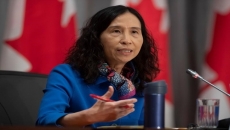
Prime Minister Justin Trudeau says Canadians can be hopeful for a summer of backyard barbecues and picnics in the park but only if we get more vaccinations into arms, and don't ease public-health restrictions until "cases are way down."
"We all want to have a summer where we can see our loved ones and invite friends over for barbecues," Trudeau said at a news conference in Ottawa Tuesday.
"We can have that summer, we can have a one-dose summer ... And a one-dose summer sets us up for a two-dose fall when we'll be able to talk about going back to school back to work and back to more normality. That's what the coming months could look like. That's what I'm excited about."
Canada is on track to hit a major milestone on the road to COVID-19 herd immunity Tuesday, with 40 per cent of Canadians — 15.2 million people — now vaccinated with at least their first dose. It should be able to get to 50 per cent by the Victoria Day weekend.
Chief Public Health Officer Dr. Theresa Tam, however, said 75 per cent is the target for first doses before lifting many restrictions won't result in a fourth wave. And as restrictions are lifted it must happen "slowly, deliberately and carefully," she said.
"This is, I hope, our final challenge," said Tam. "If we can keep on suppressing the cases and get the vaccines up, we will have a year that looks considerably better moving head."
For now, we need to remain cautious & do everything we can to protect ourselves and our communities as #COVID19vaccines continue to roll out and have more impact, easing pressure on the health system, and helping to end this pandemic!https://t.co/w27G7rHASE
— Dr. Theresa Tam (@CPHO_Canada) May 11, 2021
There are enough doses from Pfizer-BioNTech and Moderna expected to get to 75 per cent by the middle of June, and it could be faster depending on when Moderna schedules the rest of its spring shipments.
All Canadians over the age of 12 will be able to access their first dose before Canada Day. Vaccines aren't yet authorized for kids under the age of 12 but Pfizer, Moderna and AstraZeneca are testing on children now and results are expected before the end of the summer.
What's becoming more clear is that very few Canadians going forward will be getting the Oxford-AstraZeneca vaccine as their first dose. While safety concerns about the risk of vaccine-induced thrombotic thrombocytopenia remain an issue, the decision is mainly be driven by supply.
Fewer than 200,000 doses remain of the 2.3 million already shipped, and only 1.65 million more are expected before the end of June.
Alberta became the first province to say it is no longer giving AstraZeneca as a first dose, saving the 8,400 doses it has left for second shots. Manitoba Health said Tuesday it isn't changing its vaccine program, but did note it only has about 8,000 doses left and no sign of when more will be coming.
Every province is eagerly anticipating results of a British study on mixing and matching vaccines. Data could come on AstraZeneca and Pfizer as early as this week, with many health experts expecting very positive results from combining two different vaccines.
"That would offer a choice essentially, for those who have received AstraZeneca for the first dose," said Tam.
However she said for now the advice remains to give the same vaccine for second doses and Canada will ensure there are enough doses of AstraZeneca to give the second dose to the more than two million Canadians who got it as their first.
Vaccines are critical to slowing the spread of COVID-19, but Tam and Trudeau stressed they're not the only important public-health measure. Trudeau said vaccines can help stop the spread at 75 per cent with one dose, if we do the hard work to "crush" COVID-19 by staying at home.
"We've seen from waves in the past the problems that happen if restrictions are opened too early, it just leads to a greater next wave," said Trudeau.
There are still pockets of Canada where COVID-19 is not in control, including much of Alberta and Manitoba. Both provinces implemented new restrictions this week, including school closures and limits on public gatherings, but neither are in a full lockdown.
Quebec and Ontario are reporting their lowest case counts since March Tuesday — Quebec reported 660 new cases and Ontario 2,073 — and both have seen declines in hospitalizations, including intensive care patients, in the last two weeks.
Ontario's average new daily case load is two-thirds of what it was in mid-April. The province is signalling its stay-at-home order, in place now since April 8, will be extended into June. Chief medical officer Dr. David Williams said daily cases have to be well below 1,000 a day before it can be lifted.
Nationally the average daily case reports have fallen to 7,275, from a third-wave high of 8,680 on April 20. Hospitalizations and ICU cases have also started to ease, with 4,000 patients in hospital and 1,400 in the ICU Tuesday, compared with 4,300 and 1,450 a week ago.