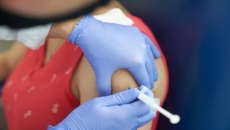
Prime Minister Justin Trudeau says Pfizer has guaranteed delivery of at least 1 million COVID-19 vaccine doses per week starting later this month.
Prime Minister Justin Trudeau is expressing caution over the use of “vaccine passports,” suggesting they could unfairly impact some people if used to decide who can go to a concert or dine at a restaurant.
While Trudeau acknowledged that proof of a COVID-19 inoculation would not be out of place for travellers who already face similar requirements for other vaccines when embarking on international jaunts, he said a similar scheme for everyday activities in Canada raises "questions of equity."
He said some Canadians cannot be vaccinated because of medical conditions, and noted people who are not prioritized for shots will have to wait much longer than others.
"These are things that we have to take into account so that yes, we're looking to try and encourage everyone to get vaccinated as quickly as possible, but we're not discriminating and bringing in unfairness in the process at the same time," Trudeau said Friday at a press conference alongside health officials.
Health Minister Patty Hajdu noted discussions are underway with international partners about how vaccine passports could be used.
She said it's important to make sure Canada is not left behind if the world makes this a new travel requirement.
But conversations around how passports could be used within Canada are a provincial matter, said Hajdu, noting provinces already oversee similar vaccination proofs required by schools and certain health-care settings.
"Those are all largely provincial decisions and of course they're very difficult ones," she said.
"But certainly I know provinces and territories are deliberating about those kinds of decisions that are coming their way as more people become vaccinated."
The questions emerged as Trudeau said Canada can expect to receive at least one million COVID-19 Pfizer-BioNTech vaccine doses per week starting later this month and lasting into early May.
Trudeau said Pfizer's updated delivery schedule was "going to make a big difference" when it begins March 22 and runs to May 10.
The influx is more than double the 444,600 doses expected next week. That's on top of additional vaccine deliveries from Moderna, expected to bring 846,000 doses the week of March 22.
More than 2.7 million doses have been administered so far.
To date, labs across 🇨🇦 have performed 25,542,543 tests for #COVID19. For the week of Feb 28-Mar 6, there were an average of 104,332 tests completed daily across Canada, of which 2.9% were positive for #COVID19. https://t.co/ZArmpJMAM3
— Dr. Theresa Tam (@CPHO_Canada) March 12, 2021
Deputy Chief Public Health Officer Dr. Howard Njoo added that Canada had administered close to 600,000 doses over the past week, the highest since the rollout began.
Over the past week there has been an average of more than 3,050 new COVID-19 cases and 31 deaths reported daily.
Chief Public Health Officer Dr. Theresa Tam said more than 2,050 patients were treated in hospital each day, including about 540 in critical care.
She added that there were now close to 3,000 variants of concern cases, with the B.1.1.7. variant accounting for more than 90 per cent.
In total, Canada has seen 899,757 cases of COVID-19, including 22,371 deaths and more than 30,670 active cases reported across the country.
Njoo touted the nation's progress following a week of remembrance in which the world marked the one-year anniversary of the pandemic.
But Njoo also warned that "racing towards the finish" could cost us hard-won successes.