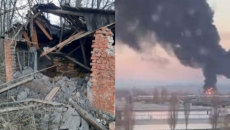
VANCOUVER - The earthquake that ravaged Turkey and Syria this week offers both lessons and warnings for people in British Columbia as images emerge of the human devastation and costly damage, Canadian seismology experts say.
John Clague, a professor emeritus in the Earth Sciences department at Simon Fraser University, said there is much to learn from the latest quake.
"It's incredibly horrific, but also quite interesting,"
Clague said that while "the big one could come any minute," the time frame for such an event in geological terms makes it hard to imagine for most people, whether they're in an earthquake-prone zone or not.
Major seismic events occur about every 500 years, he said, making them rare enough for most people to worry more about the day-to-day dangers of driving a car, for example.
"I'm sure you could have talked to the people living in one of those cities or towns in Turkey and they would have said, 'well, yeah, we know we live on our fault zone, but, you know, we haven't had a giant earthquake in hundreds of years, so why should we worry about it?'"
Clague said both individuals and governments can fall into the same trap of short-term thinking since the threat of earthquakes and other natural disasters seems distant in terms of time and space.
However, Clague credited the provincial government for investing in seismic upgrades of regional transportation infrastructure and schools, for example, though he admitted to thinking such investments are "never enough."
"I do appreciate that governments have other demands on their agenda like the opioid crisis and homelessness and we don't have unlimited amounts of public moneys to deal with all the problems we face," Clague said. "It's a balancing act."
Clague said cities like Vancouver are fortunate to have modern building codes that are regularly revised and updated, while also being far away from the likely epicentre of the next major earthquake to avoid the "worst case scenario" damage seen after 7.8 and 7.5 magnitude quakes in Turkey and Syria this week.
"Syria is quite a ways away from the epicentre of either of those big earthquakes, and they had buildings collapsing there," Clague said. "So, that shouldn't happen, you know, in a country that has proper construction practices in earthquake zones."
He added that he doesn't like to frighten people with dire predictions, but urges people to be prepared for earthquakes even though they're rare and Vancouver is somewhat insulated from the worst-case scenario seen in Turkey and Syria.
"I just reinforce the fact that even though Vancouver hasn't been damaged by an earthquake, you know, Vancouver's only 130 years old or 140 years old," he said. "It's always a good idea to be prepared and being prepared doesn't really require that much effort."
For Sharia Alam, a professor in the University of British Columbia's School of Engineering, earthquakes reveal whatever deficiencies there may be in a region's building and transportation infrastructure.
In Turkey and Syria, for instance, most of the damage and destruction likely stemmed from how old buildings, bridges, and roads were at the time of the quake, he said.
Canada, he said, has "learned lessons from various events" that have seen the country's building codes mature and modernize thanks to a "constant effort to improve our design code."
However, older buildings and infrastructure built before the 1970s remains particularly vulnerable, Alam said, pointing to a 2013 study commissioned by the Insurance Bureau of Canada that estimated $75 billion in potential damage in B.C. in the event of a 9.0 magnitude earthquake.
Earthquakes Canada said the Cascadia megathrust earthquake with a magnitude of 9 hit the west coast of North America on Jan. 26, 1700, sending a massive tsunami across the Pacific that reached Japan.
Alam said governments of all levels have to step-up efforts to not only educate people, but also take "strong initiatives" to identify vulnerable infrastructure and prioritize repairs and retrofitting to ensure scenarios like that in Turkey and Syria don't happen here.
"I think it requires a substantial amount of effort, energy, (and) funding," he said.
Last month, the B.C. and federal government jointly announced the province is ramping up an early earthquake detection system in "high seismic risk areas."
The national earthquake early warning system already has several hundred sensors overseen by Natural Resources Canada and the new initiative would see up to 50 additional sensors that would go online in 2024.