Sunday, December 21, 2025
ADVT 
National

Two-thirds favour keeping two-metres physical distance: Leger poll

Darpan News Desk The Canadian Press, 23 Jun, 2020 08:43 PM
  • Two-thirds favour keeping two-metres physical distance: Leger poll

Two-thirds of Canadians don't want to relax physical distancing rules imposed to curb the spread of COVID-19, a new poll suggests.

And even if they were relaxed, a strong majority wouldn't be comfortable taking part in activities that would bring them closer to other people, like going to a movie theatre.

Sixty-six per cent of respondents to the poll, conducted by Leger and the Association for Canadian Studies, said two metres should remain the safe distance kept between people, as recommended by Canada's public health authorities.

Just 12 per cent favoured reducing the distance to 1.5 metres, as is required in many European countries, and only 10 per cent favoured a reduction to one metre, the minimum recommended by the World Health Organization.

If the physical distancing rule were reduced to one metre, just 40 per cent said they'd be comfortable dining in a restaurant, 28 per cent going to a movie theatre, 24 per cent to a gym and 21 per cent to a bar or night club.

"We've been schooled on two metres for over three months now," said Leger executive vice-president Andrew Enns.

"It's difficult for Canadians to now suddenly start to be convinced that it's OK to make that a closer distance."

The online poll of 1,521 adult Canadians was conducted June 19 to 21. It cannot be assigned a margin of error because internet-based polls are not considered random samples.

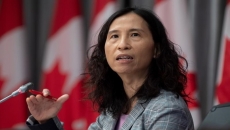
Canada's chief public health officer, Dr. Theresa Tam, said Tuesday that she and her provincial counterparts are constantly reviewing their recommendations for safe physical distancing but, for now, agree that two metres should remain the rule.

"The two-metre distance is based on the usual sort of way droplets that are emitted from people, if they're coughing or sneezing et cetera, fall to the ground or fall on top of someone else," she said.

"The bottom line is that one metre catches a whole bunch of droplets. Two metres, there will be more droplets that you may be able to avoid if you kept the two-metre distance."

Enns said the reluctance to get closer with their fellow Canadians reflects a "very persistent level of anxiety" about the deadly new coronavirus that causes COVID-19, despite a steady decline in the number of new cases in Canada.

Just 43 per cent of respondents said they believe the first wave of the pandemic is over and 74 per cent think there'll be a second wave, according to the poll. And 51 per cent said they are very or somewhat afraid of contracting COVID-19.

Forty-two per cent said they believe the worst of the crisis is over but an equal number said we're in the worst of it now or the worst is yet to come (10 per cent and 32 per cent, respectively).

Almost half (46 per cent) said they find it very or somewhat stressful to leave the house and go out in public.

Sixty-two per cent said it will take time before life returns to normal, while 28 per cent said it will never return to normal.

All those measures of continued anxiety about COVID-19 are likely contributing to people saying "I'm not going closer than two metres because this thing's not over," Enns said.


MORE National ARTICLES

RCMP to ramp up online threat monitoring

RCMP to ramp up online threat monitoring
Canada's national police force wants a digital tool to harvest data from a sweeping variety of online sources, including the darkest reaches of the internet, to provide early information on threats such as disease outbreaks and mass shootings. The software would allow an RCMP officer to quickly mine data about a person's internet activities, from an emoji posting on Facebook to an illicit firearm purchase on the so-called darknet.

RCMP to ramp up online threat monitoring

Canadian MPs meet online in first virtual session of House of Commons

Canadian MPs meet online in first virtual session of House of Commons
Canada's first-ever virtual House of Commons kicked off this afternoon with almost 90 per cent of MPs dialed in to start. The House of Commons special committee on COVID-19 is meeting via videoconference this afternoon. Bloc Quebecois Leader Yves-Francois Blanchet said in his opening statement that he could see that 297 of the 338 MPs were online at that moment.

Canadian MPs meet online in first virtual session of House of Commons

Justin Trudeau says mom Margaret Trudeau recovering after apartment fire

Justin Trudeau says mom Margaret Trudeau recovering after apartment fire
Prime Minister Justin Trudeau said his mother was doing fine Tuesday after a fire at her downtown Montreal apartment sent her to hospital. Margaret Trudeau, 71, was transported to hospital after the fire that broke out on the patio of the building just before midnight Monday.

Justin Trudeau says mom Margaret Trudeau recovering after apartment fire

Hundreds more COVID deaths expected but Trudeau says Canada is making progress

Hundreds more COVID deaths expected but Trudeau says Canada is making progress
Thousands more people are expected to contract COVID-19 and hundreds will likely die in the coming week, according to government projections, despite the progress the country has made in fighting the pandemic. Canada's case rate is now doubling every 16 days rather than three to five days seen about three weeks ago, Dr. Theresa Tam, the country's top public health officer, said on Thursday.

Hundreds more COVID deaths expected but Trudeau says Canada is making progress

HSBC Bank Canada reports Q1 profit down as it expects downturn to hurt loans

HSBC Bank Canada reports Q1 profit down as it expects downturn to hurt loans
HSBC Bank Canada reported a drop in its first-quarter profit compared with a year ago as it took a charge related to bad loans it expects due to the downturn in the economy. The bank says it earned a profit attributable to common shareholders of $54 million or 11 cents per share for the quarter ended March 31. That's compared with a profit of $158 million or 32 cents per share in the first three months of 2019.

HSBC Bank Canada reports Q1 profit down as it expects downturn to hurt loans

Local restaurants feel squeezed by delivery apps' commission fees

Local restaurants feel squeezed by delivery apps' commission fees
Restaurants struggling to survive during the COVID-19 crisis have turned to take-out and delivery, but the fees charged by food-delivery companies are eating away their bottom line, some operators say. Physical distancing measures have decimated dine-in service, which accounts for most industry revenue, said Mark von Schellwitz, a vice-president of the non-profit Restaurants Canada.

Local restaurants feel squeezed by delivery apps' commission fees