Sunday, December 21, 2025
ADVT 
National

Two-thirds favour keeping two-metres physical distance: Leger poll

Darpan News Desk The Canadian Press, 23 Jun, 2020 08:43 PM
  • Two-thirds favour keeping two-metres physical distance: Leger poll

Two-thirds of Canadians don't want to relax physical distancing rules imposed to curb the spread of COVID-19, a new poll suggests.

And even if they were relaxed, a strong majority wouldn't be comfortable taking part in activities that would bring them closer to other people, like going to a movie theatre.

Sixty-six per cent of respondents to the poll, conducted by Leger and the Association for Canadian Studies, said two metres should remain the safe distance kept between people, as recommended by Canada's public health authorities.

Just 12 per cent favoured reducing the distance to 1.5 metres, as is required in many European countries, and only 10 per cent favoured a reduction to one metre, the minimum recommended by the World Health Organization.

If the physical distancing rule were reduced to one metre, just 40 per cent said they'd be comfortable dining in a restaurant, 28 per cent going to a movie theatre, 24 per cent to a gym and 21 per cent to a bar or night club.

"We've been schooled on two metres for over three months now," said Leger executive vice-president Andrew Enns.

"It's difficult for Canadians to now suddenly start to be convinced that it's OK to make that a closer distance."

The online poll of 1,521 adult Canadians was conducted June 19 to 21. It cannot be assigned a margin of error because internet-based polls are not considered random samples.

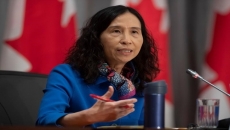
Canada's chief public health officer, Dr. Theresa Tam, said Tuesday that she and her provincial counterparts are constantly reviewing their recommendations for safe physical distancing but, for now, agree that two metres should remain the rule.

"The two-metre distance is based on the usual sort of way droplets that are emitted from people, if they're coughing or sneezing et cetera, fall to the ground or fall on top of someone else," she said.

"The bottom line is that one metre catches a whole bunch of droplets. Two metres, there will be more droplets that you may be able to avoid if you kept the two-metre distance."

Enns said the reluctance to get closer with their fellow Canadians reflects a "very persistent level of anxiety" about the deadly new coronavirus that causes COVID-19, despite a steady decline in the number of new cases in Canada.

Just 43 per cent of respondents said they believe the first wave of the pandemic is over and 74 per cent think there'll be a second wave, according to the poll. And 51 per cent said they are very or somewhat afraid of contracting COVID-19.

Forty-two per cent said they believe the worst of the crisis is over but an equal number said we're in the worst of it now or the worst is yet to come (10 per cent and 32 per cent, respectively).

Almost half (46 per cent) said they find it very or somewhat stressful to leave the house and go out in public.

Sixty-two per cent said it will take time before life returns to normal, while 28 per cent said it will never return to normal.

All those measures of continued anxiety about COVID-19 are likely contributing to people saying "I'm not going closer than two metres because this thing's not over," Enns said.

MORE National ARTICLES

Ottawa helping guide, but not dictating, provincial reopening plans: Trudeau

Ottawa helping guide, but not dictating, provincial reopening plans: Trudeau
With Canada's two most populous provinces poised to outline plans for a gradual return to normalcy, Prime Minister Justin Trudeau said Monday that Ottawa will help guide, but not dictate, how provinces and territories should start easing restrictions. Ontario and Quebec together account for more than 80 per cent of the country's COVID-19 cases.    

Ottawa helping guide, but not dictating, provincial reopening plans: Trudeau

Crisis lines face volunteer, cash crunch even as COVID-19 drives surge in calls

Crisis lines face volunteer, cash crunch even as COVID-19 drives surge in calls
Despite a surge in demand due to COVID-19, many distress centres across Canada are dangerously close to folding thanks to major declines in both volunteers and revenue. Stephanie MacKendrick, CEO of Crisis Services Canada, which runs the only national suicide-specific helpline in Canada, says her organization relies on a network of approximately 100 community distress centres across the country to field calls from people.

Crisis lines face volunteer, cash crunch even as COVID-19 drives surge in calls

Conservatives gear up to grill government in modified return of House of Commons propose and oppose: Tories

Conservatives gear up to grill government in modified return of House of Commons propose and oppose: Tories
Conservative Leader Andrew Scheer laid out Monday the numerous lines of inquiry his party intends to follow this week as a modified version of a House of Commons sitting gets underway. They include the state of the nation's emergency supply stockpile, the mishmash of federal economic benefit programs that allow some to fall through the cracks and to what extent the minority Liberals are backstopping provincial efforts to reopen their economies, Scheer said.

Conservatives gear up to grill government in modified return of House of Commons propose and oppose: Tories

Learning to live with COVID-19 requires permanent fixes to vulnerable settings

Learning to live with COVID-19 requires permanent fixes to vulnerable settings
Canada's chief public health officer warned Monday there is still a lot we don't know about the virus that causes COVID-19, but said stopping this pandemic or preventing a future one will require more than just physical distancing and handwashing. Dr. Theresa Tam said we simply do not know yet whether someone who has had COVID-19 will be immune from getting it again, or how long that immunity will last.

Learning to live with COVID-19 requires permanent fixes to vulnerable settings

B.C. university creates institute to take microscope-telescope view of pandemic

B.C. university creates institute to take microscope-telescope view of pandemic
The COVID-19 pandemic has placed the world at a tipping point that's challenging social, political, economic and environmental structures, says the director of a new academic research institute at British Columbia's Royal Roads University. Dr. Thomas Homer-Dixon said Monday the pandemic is an event with the power to cause those structures to fall like dominos or shift radically to new paths.

B.C. university creates institute to take microscope-telescope view of pandemic

Drugs and cash seized from a Whalley area residence in Surrey

Drugs and cash seized from a Whalley area residence in Surrey
Illicit drugs and cash have been seized from a residence in the Whalley area following an investigation by the Surrey RCMP. The investigation began on March 5th, 2020 by the Surrey RCMP Community Response Unit (CRU). CRU observed suspicious activity consistent with drug trafficking at a residence in the 11400 block of 124 street.     

Drugs and cash seized from a Whalley area residence in Surrey