

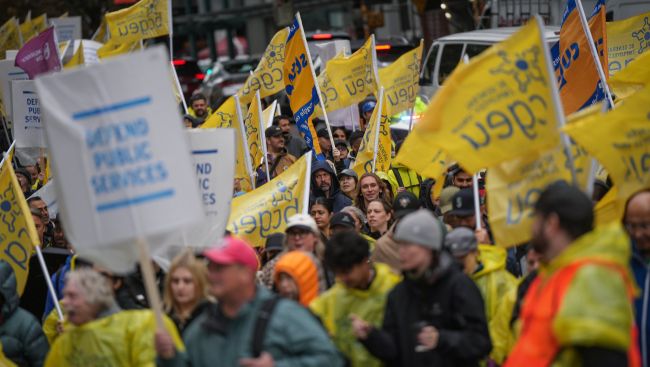
Hundreds of British Columbia public sector workers marched through downtown Vancouver Wednesday in a push for a new contract, after talks with government negotiators broke down shortly after they had resumed earlier this week.
Paul Finch, president of the BC General Employees' Union, told the crowd the union "didn't set out to pick a fight" with the government.
Rather, he said it listened to the experiences and concerns of its workers and brought them forward at the bargaining table.
"We told them of a reality of wildfire fighters making $28 an hour, forced to work endless overtime without seeing their families over the summer, just to make enough money to get by," he said, drawing boos from the crowd.
Finch said union negotiators had returned to the bargaining table on Monday with the goal of securing a deal, but the talks were brief as government negotiators presented a contract that was little changed from an earlier offer.
He noted the B.C. legislature is set to resume sitting on Oct. 6.
"If they don't want to come to the bargaining table, we're going to bring the bargaining table to the legislature," Finch said.
The escalating strike is into its fifth week.
The union's strike fund is "very healthy," Finch said in an interview following the rally.
Members of other unions, including the Professional Employees Association, BC Nurses' Union, BC Teachers' Federation and United Steelworkers also joined the demonstration in what the BCGEU called a show of solidarity with its workers.
The crowd chanted "union power" as they marched through the streets of downtown Vancouver.
Melissa Moroz, executive director of the Professional Employees Association, said it was inspiring to see the crowd.
"It's great to have the labour movement all together," she said.
"This strike is bigger than any one of us. It's not just about the people who are on strike," she said. "This strike is about a fight for public services across this province."
She said the job action was about fairness, respect and dignity, not just wages.
Premier David Eby said Wednesday that it was "crucial" to resolve the dispute quickly and the parties need to be at the bargaining table "hammering it out."
The New Democrat government was trying to balance the valuable work of public servants and the fiscal reality the province faces, he told an unrelated news conference in Langford, B.C.
He said the government made a "good faith" offer of a five-per-cent wage increase over two years, with "special consideration" for those in lower paid roles.
"We're fiscally constrained right now. The global economy is slowing. There's huge cost inflation pressuring not just our government but governments around the world and across the country," the premier said.
After talks collapsed on Monday, Finch said they wouldn't resume until the province came back with a "real offer."
The BCGEU said in a statement on Monday that it countered the government's offer of a five per cent wage increase over two years with a request for eight per cent over the same period.
About 15,000 of the union's 34,000 workers involved in the dispute have been conducting some form of job action, including walking picket lines and refusing overtime.
Pickets are up across the province at dozens of provincial liquor stores, at liquor and cannabis distribution warehouses and at government offices.
In a statement following the rally, the BCGEU said members had walked off the job at 25 additional sites on Wednesday, bringing the total to 167 across B.C.
Annette Toth, president of Movement of United Professionals, said public sector workers were telling the province they are facing an affordability crisis.
"We are essential for the success of this province," Toth said at the rally, drawing cheers from the crowd. "And that starts by making sure that people who do the hard work every day to keep our province running are paid appropriately, so they can afford to live and work in (their) communities and afford to put food on their table for their families."
She said it felt like the government had its ears plugged.
"They're not listening," Toth said.
Picture Courtesy: THE CANADIAN PRESS/Darryl Dyck


