

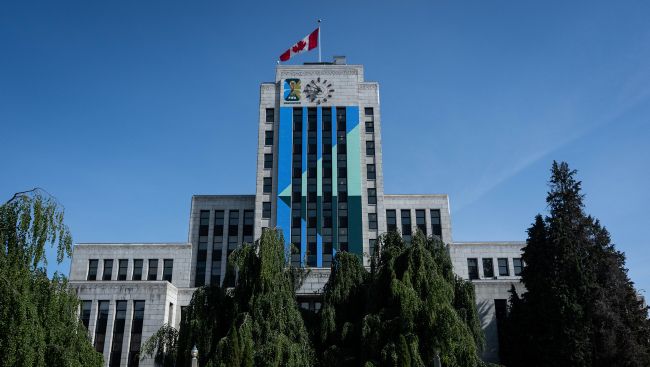
The City of Vancouver has issued a human rights plan for the FIFA World Cup that begins next month, saying people who are homeless will still be able to shelter in parks overnight, but structures will have to be removed during the day under pre-existing rules.
The city said in the plan released Monday that while Vancouver is required by FIFA to conduct beautification, such as covering construction sites and removing graffiti, that won't impact human rights.
The document also said bylaw officers will keep parks and sidewalks "free of structures and in compliance with bylaws" during the day, under city rules that already exist.
"Our day-to-day bylaw compliance work will continue," said Vancouver deputy city manager Sandra Singh during a media availability at city hall Monday. "When we do that work, we require people to bring down temporary structures, tents, canopies.
"We do require that people pack up belongings that are taking up sidewalk or spaces in parks so that the public realm can be usable by the whole community during the day. What we don't ask is that people leave their neighbourhoods. We don't ask that people leave that block."
A preliminary version of the plan released in February triggered concern from Downtown Eastside neighbourhood advocates, who noted that it didn't promise to increase supports for people who are homeless, while leaving open the possibility of tent and structure removals.
A coalition of organizations in the neighbourhood said at the time that the City of Vancouver did not conduct "robust, meaningful public engagement with peoples, collectives, and organizations who will be most impacted by FIFA’s descent into Vancouver," noting offers to meet were "routinely rebuffed."
"Instead, the (Host City) Committee told us that its plan would rely primarily on existing city policies and bylaws, as well as provincial and federal legislation," the coalition, which includes the BC Civil Liberties Association and the BC Poverty Reduction Coalition, said in February.
Jerome Igbokwe, staff counsel for the BC Civil Liberties Association, said Monday that the new action plan showed that the city had moved slightly in handling homeless communities during the World Cup but "doesn't quite address the issue."
While funding to some community groups have increased, he said he is not sure that alone can address the issue, since existing mechanisms are not working in creating additional shelter spaces for homeless people to go, especially with the large influx of visitors expected for the World Cup.
"I think what it means is just that the city has decided that it's going to prioritize beautification over human beings," he said. "And what it means is that people are going to be at risk.
"If people are sheltering anywhere they can and if they don't even have a specific shelter, what happens at three in the morning (when) someone has come to watch the World Cup — someone (that) is drunk — and they encounter someone who is sheltering?
"What do you think is going to happen? A drunk visitor and a vulnerable member of the community. So, I think there is a risk to health, a risk to livelihood."
Singh said the city believes it has addressed the primary concerns that were raised by critics in the last few months, as it worked with community partners in creating the final action plan announced Monday.
She said the city is "leveraging" existing services in the community meant to support vulnerable populations during game days, when there may be more encounters between them and attending fans.
But Vancouver will also put in additional resources in specific zones — such as along False Creek near Science World leading up to each game — focusing on community-led patrols in place of police and other measures to create a positive environment for everyone.
The patrols and outreach program with be carried out by groups such as Goodnight Out, Atira Women’s Resource Society, Mission Possible, and Moccasin Maffia through Watari Counselling and Support Services, with additional funding provided by the City of Vancouver.
"Many of the concerns that they raised really reflect their care for vulnerable residents and people experiencing risk and different types of marginalization in the Downtown Eastside," Singh said. "We do think that the plan and the way that we've approached it, it builds on the excellent services that are already out in the Downtown Eastside. It is a very service-supported environment already.
"And so, what we've done is we've identified through the community feedback some areas of unique concern to the FIFA World Cup that we've added in some additional contracts and services."
The final document responded to a hypothetical question about the possibility of visitors having "negative interactions" with people who are homeless by saying volunteers will "support public realm interactions" and help visitors "know where to go."
All 16 host cities for the FIFA World Cup tournament are required to have a human rights action plan for the tournament, developed under the international soccer federation's framework.
The City of Vancouver said its planning has relied on experiences hosting major sporting events and concerts but did not refer as much to the 2010 Winter Games, as the format of the Olympics differed greatly from that of hosting seven World Cup games.
“Hosting seven matches this summer is a once-in-a-generation opportunity for our city," Mayor Ken Sim said in a statement. "Vancouver has a strong track record of hosting major international events, and we’re ready to deliver a tournament that is safe, accessible and welcoming for everyone.”
Picture Courtesy: THE CANADIAN PRESS/Ethan Cairns


