OTTAWA — "My wife's from a rural area, gun ownership wasn't just for the farm, it was also for a certain level of security when you're ways away from police, immediate police assistance."
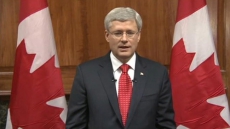
— Prime Minister Stephen Harper, speaking to the Saskatchewan Association of Rural Municipalities on March 12.
"Gun owners in Canada are not allowed to take the law into their own hands. Nobody here is suggesting they should be able to do that. In fact we have had, in many parts of this country, widespread gun ownership for many years, for various reasons including security, without people taking the law into their own hands. So that's just not the reality of the situation."
— Prime Minister Stephen Harper, speaking at a news conference in Mississauga, Ont., on March 19.
———
Politicians — including NDP Leader Tom Mulcair, Quebec Premier Philippe Couillard and former Ontario attorney general Michael Bryant — were quick to pounce on Prime Minister Stephen Harper's comment that guns provide "a certain level of security" to people who live far away from police stations.
Some even went as far as to say the prime minister was suggesting Canadian gun owners should take the law into their own hands — a view Harper later called "patently ridiculous."
So is the prime minister correct in saying he was misinterpreted?
Spoiler alert: The Canadian Press Baloney Meter is a dispassionate examination of political statements culminating in a ranking of accuracy on a scale of "no baloney" to "full of baloney" (complete methodology below).
This one earns a rating of "a little baloney" — the statement is mostly accurate but more information is required.
Here's why:
THE FACTS
The prime minister made his original comments at a March 12 event held by the Saskatchewan Association of Rural Municipalities while being questioned about his government's plans after dismantling what the moderator called "the ineffective and wasteful long-gun registry."
The prime minister went into detail defending Bill C-42, dubbed the Common Sense Firearms Licensing Act, which is currently before the House of Commons.
The following day, Jenni Byrne, the Conservatives' national campaign manager, sent a fundraising email to party supporters extolling Harper's comments — and specifically the parts about guns providing safety (a word she mentioned twice in the first three paragraphs of her message) to people in rural areas.
"As someone who grew up in a rural part of our country, I was proud to hear what the Prime Minister had to say yesterday," Byrne wrote on March 13.
"He said that gun ownership is important for safety for those of us who live a ways from immediate police assistance. Our Conservative party recognizes that guns play an important role in the livelihoods, recreation, and safety of many Canadians. And we're standing up for responsible gun-owning Canadians."
Let's look at what was said about Harper's comments.
The prime minister, Bryant told the Ottawa Citizen, "misstated" the truth about domestic law by linking gun ownership with the right of rural Canadians to use firearms for their own safety.
"It's not Canadian law," Bryant said. "It's vigilantism. People are going to find themselves facing the criminal justice system and being charged with serious crimes if they decide to follow what the prime minister is suggesting."
Mulcair did not conflate Harper's comments about guns providing safety to rural Canadians with the notion of people taking the law into their own hands. The NDP leader accused the prime minister of trying to drive a wedge between rural and urban dwellers.
"There's something frankly surprising when a prime minister tries to say to people they should use their guns to protect themselves," he said.
"Stephen Harper is using the gun registry issue to divide Canadians. This time he's pitting rural Canada against people who live in cities."
Couillard, meanwhile, said Canadians don't want to live in a country with an "abundance of firearms."
On March 19, at a campaign-style event in Mississauga, a reporter asked Harper if his comments in Saskatchewan might "lead to vigilante justice." Harper called that interpretation "patently ridiculous."
The Prime Minister's Office has also said that anyone who uses a firearm to commit a crime will be prosecuted to the fullest extent of the law.
What does the Criminal Code of Canada say about using guns in self-defence?
Under Section 34, a person is not guilty of a crime if they believe "on reasonable grounds" that someone is using force — or is about to — against them or another person.
Nor are they guilty of a crime if their actions are committed in self-defence. The person's actions must also be "reasonable in the circumstances."
A host of factors come into play, such as the nature of the force or threat; if there were other ways to respond to the threat; whether anyone threatened to use a weapon; and the age, size, gender and physical capabilities of the people involved in the altercation.
There are also special regulations that allow someone to carry a gun to protect themselves in exceptional circumstances:
— if their life, or someone else's, is in imminent danger from one or more people;
— if police protection is not sufficient in the circumstances; and
— if having a restricted firearm or prohibited handgun can be reasonably justified for protecting the person or someone else from death or "grievous bodily harm."
Examples of people who might need those regulations are police informants or prosecutors in gang cases.
WHAT THE EXPERTS SAY
"It's so case-by-case...," says Ottawa-based criminal defence lawyer Paul Lewandowski about the laws governing self-defence — including whether or not someone can use a gun.
The bottom line, he says, is that the act of self-defence — whether that means wrestling someone to the ground or shooting them — has to be reasonable in the circumstances.
"So, a guy is spitting on you, which constitutes an assault, you don't get to shoot him. A guy is coming at you with a knife, is the act reasonable in shooting him? It can be," Lewandowski said.
Lawyer Solomon Friedman of the Toronto firm Edelson Clifford D'Angelo Friedman LLP says some people are mistaking the use of a gun in self-defence for vigilante justice, which are two entirely separate things.
"Vigilantism means you take the law into your own hands and you punish a wrongdoer with force extra-judicially. That's vigilantism," he said.
"Self-defence is when you defend yourself, your family, your property against an imminent threat. It's not about punishment. You're not punishing the person who's doing this. You're defending yourself."
THE VERDICT
At no time did the prime minister suggest people who live far away from police stations could use their guns to take the law into their own hands, as Bryant suggested. Harper has not encouraged anyone to use guns to carry out vigilante justice — which as Friedman points out is different from self-defence.
It's not even clear Harper was talking about self-defence when he made the initial gun comment. The prime minister was vague about the nature of the security that guns provide to rural Canadians. It is possible that he was referring to threats such as wild animals — although the fact that he and Byrne both explicitly said "police" and not bylaw or conservation officers suggests he meant a human threat.
But Byrne's email may also leave the prime minister's comments open to interpretation.
So Harper is correct to claim his gun comments were misinterpreted by people who said he was advocating for vigilante justice. Yet the prime minister has been vague about exactly what sort of threats he was talking about, and a little more information is needed.
For the reasons, Harper's statement contains "a little baloney."
METHODOLOGY
The Baloney Meter is a project of The Canadian Press that examines the level of accuracy in statements made by politicians. Each claim is researched and assigned a rating based on the following scale:
No baloney — the statement is completely accurate
A little baloney — the statement is mostly accurate but more information is required
Some baloney — the statement is partly accurate but important details are missing
A lot of baloney — the statement is mostly inaccurate but contains elements of truth
Full of baloney — the statement is completely inaccurate.